Special Purpose Entity Structures in CRE Loan Underwriting
Securitization demands SPE structures; relationship lenders do not.

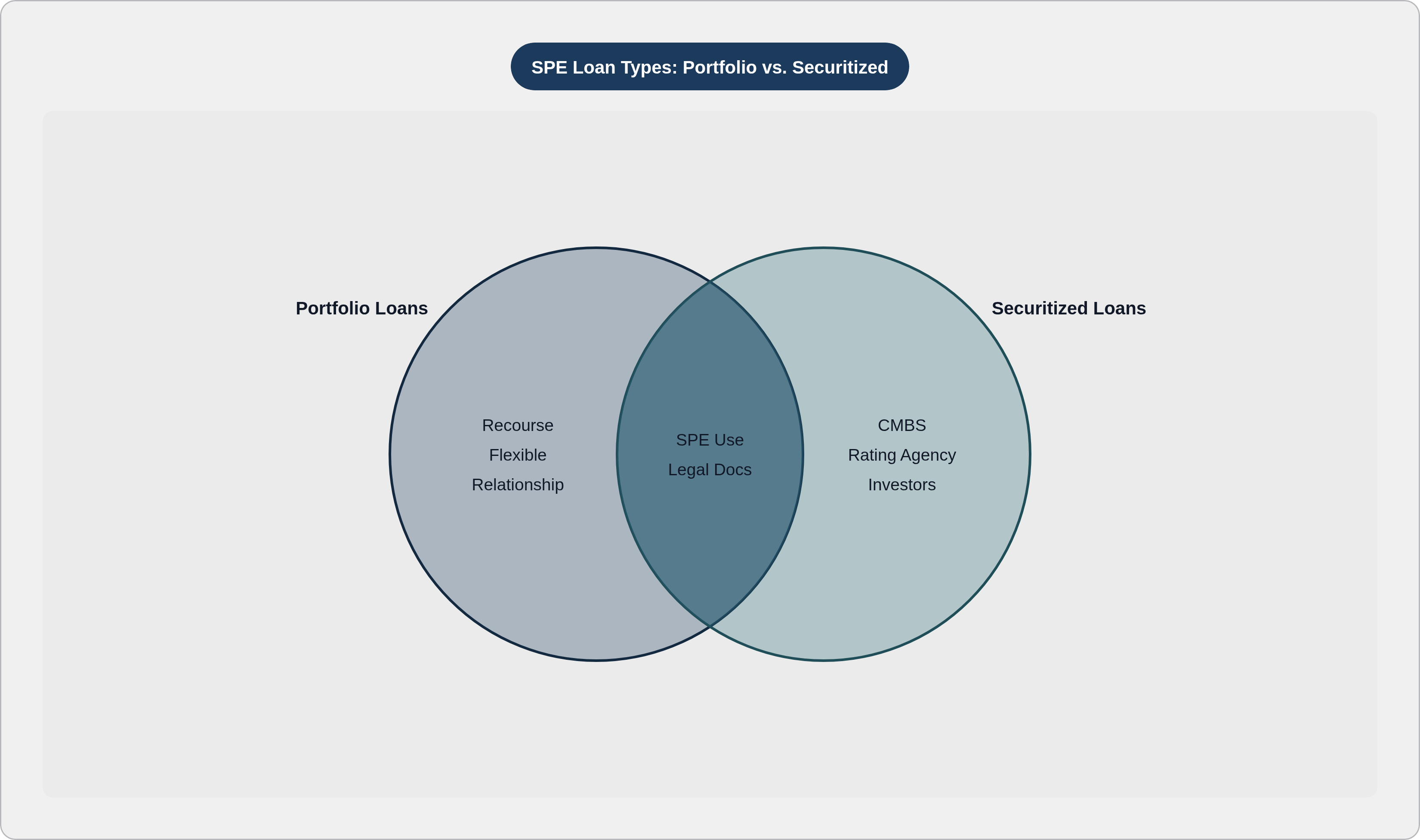
The clearest way to understand where SPE requirements come from is to look at where they are conspicuously absent. Small-balance community bank loans, SBA loans, many credit union transactions: these rarely require SPE borrowers. The lender holds the loan, knows the sponsor, and manages risk through relationship and recourse rather than structural isolation.
The moment a loan touches the capital markets, that tends to change. Conduit CMBS, single-asset/single-borrower executions, CRE CLOs, structured bridge facilities, mezzanine financing, and institutional lending platforms generally require SPE borrowers as a baseline. Agency lenders, Fannie Mae and Freddie Mac among them, mandate SPE structures. Life company lenders follow the same pattern on virtually all transactions. The operative variable is not loan size alone; it is whether the lender intends to hold or securitize, and whether the deal will be scrutinized by rating agencies or investors who need to understand what they are buying.
That raises an important question: why does the intended exit matter so much to the structural requirements at origination? Because securitization investors are not buying a relationship with the sponsor. They are buying a legal claim to a defined cash flow from a defined asset, and the SPE structure is what makes that claim legible and enforceable independent of whatever else the sponsor is doing with their life. The structure exists to serve the investor who will never meet the borrower.
CREFC guidance has generally held that independent director provisions are required on CMBS loans above $20 million, and their absence has historically been treated as a credit negative by rating agencies. That threshold is worth internalizing because it tells underwriters at the outset how much rigor the SPE review actually demands. Deal size, lender type, and intended exit: those three variables determine whether SPE analysis is a checkbox or the center of the credit evaluation.
The Provisions That Actually Create Bankruptcy Remoteness
Bankruptcy remoteness is not a single clause buried somewhere in the operating agreement. It is a stack of interlocking provisions drawn from three sources: organizational documents, loan covenants, and applicable law. Each layer does a distinct job, and the stack only holds if every layer is there.
The foundation is separateness covenants. The SPE must have its own tax identification number, its own bank accounts, its own books. It cannot guarantee the obligations of affiliated entities, cannot commingle assets with any other entity, cannot incur debt outside the secured loan, and cannot merge or consolidate with any affiliate. These provisions exist to ensure that if a court ever has to examine this entity, it sees a truly independent operation rather than a legal fiction draped over an undifferentiated pool of sponsor assets.
The governance layer is the independent director or independent manager. This person, named in the operating agreement before closing, must consent before the SPE can file for voluntary bankruptcy, appoint a receiver, make an assignment for the benefit of creditors, or admit an inability to pay debts. The structural logic is not complicated: the sponsor cannot opportunistically file for bankruptcy with the SPE to disrupt a lender's enforcement action, because a party whose fiduciary duty runs to the entity and its creditors, not to the sponsor, has to agree first.
Whether that actually works in practice has been an open question for a long time. The 2025 bankruptcy case In re 301 W. North Avenue, LLC resolved at least part of it. A court dismissed a voluntary bankruptcy filing made without independent manager approval and held that organizational language limiting the independent manager's fiduciary duties to the SPE and its creditors is enforceable and does not violate public policy. That is an important precedent. One ruling does not close the conversation, but it moves the needle meaningfully toward the structure's proponents.
The continuity layer is the Springing Member. If a non-SPE member ceases to be a member of the LLC, the Springing Member automatically steps in, preventing forced dissolution and allowing the entity to continue operating. This provision is frequently overlooked in initial reviews. That is a mistake. Its absence creates a clear path to dissolution that undermines every other protection in the stack.
Two additional layers close out the framework. Bad boy guaranties create personal liability for the sponsor if they trigger specific carve-outs to the otherwise non-recourse loan structure, and a voluntary bankruptcy filing in violation of SPE provisions is a named trigger in most standard packages. This does not prevent a filing; it creates a financial deterrent sufficiently severe that rational sponsors tend to avoid it. Non-consolidation opinions from legal counsel provide written comfort that the SPE will not be consolidated with its parent or affiliated manager in a bankruptcy proceeding. CMBS lenders and most institutional lenders require these as a condition of closing.
One clarification before moving on, because it matters enormously: "bankruptcy remote" is not "bankruptcy proof." SPEs have filed for bankruptcy. The structure limits exposure and creates deterrents; it does not immunize anyone from anything. Lenders who conflate the two are assessing the wrong thing entirely.
How SPE Structure Shapes the Underwriting Analysis Itself
Standard CRE underwriting is a financial exercise. Net operating income, debt service coverage, loan-to-value: these are the levers. SPE structure adds a parallel analytical layer that is legal and operational rather than financial, and the two layers have to be evaluated simultaneously. Most underwriters are reasonably comfortable with the financial side. The legal and operational layer is where things get interesting, usually in ways nobody enjoys.
The underwriter's SPE review runs along four distinct lines of inquiry. First, entity formation quality: is this LLC actually formed for a single, limited purpose, and does the operating agreement contain all the separateness covenants the loan program requires? Second, governance completeness: is the independent director or manager properly named and appointed, and is the consent requirement for bankruptcy unambiguously drafted? Third, operational separateness: does this entity actually operate in isolation, with separate accounts and separate books, or does the separateness exist on paper only? The distinction matters enormously in court, and it is the one most sponsors underinvest in. Fourth, sponsor and affiliate health.
That fourth line is where the "not bankruptcy proof" caveat becomes directly relevant. General Growth Properties is the canonical example. During the 2008 financial crisis, GGP filed for Chapter 11 with over 150 SPE borrowers included in the filing, despite many of them having performing loans and functional separateness provisions. Lenders on those individual assets found themselves entangled in a sprawling bankruptcy that the SPE structure was supposed to prevent. The structure limited exposure and ultimately produced relatively favorable outcomes for secured lenders, but the episode established a durable lesson: SPE quality does not eliminate sponsor contagion risk. It reduces and delays it. Underwriters who do not assess the financial condition of the sponsor's broader enterprise are relying on a partial analysis, and partial analyses have a way of becoming expensive ones.
It is also worth noting that loan structure variables interact with SPE requirements in ways that are not always intuitive. HVCRE designation, which applies to high-volatility commercial real estate loans and carries a 150% risk weight under the standardized approach, is unaffected by SPE structure. The SPE framework does not reduce capital treatment; it informs how lenders price and structure around it. Bridge and construction loans add further complexity because the underwriter must evaluate the SPE's fitness for a staged funding structure against a proforma business plan, not against in-place income. The SPE that looks fine on a stabilized asset looks materially different when you run out three years of draws on a construction timeline.
Where Documentation Complexity Concentrates in SPE-Structured Deals
SPE-structured loans generate a documentation stack that is materially larger than conventional CRE transactions, and the complexity does not concentrate evenly. It concentrates in specific documents and specific provisions. Knowing where to look is itself a skill, which sounds obvious until you watch someone spend three hours on the wrong document.
The core organizational document set includes the articles of organization or certificate of formation, the operating agreement, resolutions authorizing the loan transaction, and incumbency certificates confirming authorized signatories. The operating agreement is where most of the analytical work happens, and it is where errors of omission are most consequential. A missing Springing Member provision or an ambiguously drafted independent director consent requirement does not look like much at closing; it becomes a significant problem at enforcement. These are not hypothetical risks. They are the kinds of provisions that surface during workouts and produce decidedly unpleasant conversations about what everyone agreed to three years earlier.
Legal opinions required at closing include the non-consolidation opinion, enforceability opinion, and good standing and authority opinions. Counsel issuing a non-consolidation opinion is conducting an independent substantive review of whether the separateness provisions will hold; a lender should treat that opinion as a diligence input, not a formality.
Post-closing, the loan documents embed ongoing compliance obligations: separateness covenant maintenance, restrictions on additional debt or encumbrances, and transfer and change-of-control provisions. These do not expire at closing. They are live obligations throughout the loan term, and monitoring them is a lender responsibility, not a sponsorship one.
The Corporate Transparency Act added a new layer that did not exist in prior cycles. SPEs subject to CTA must report beneficial ownership information for owners and those exercising substantial control. The open question, one that requires counsel on a deal-by-deal basis, is whether an independent director's control over bankruptcy filing decisions constitutes "substantial control" triggering reporting obligations. This is not an academic question; it has practical compliance implications for every SPE in a lender's portfolio.
Multi-entity sponsor structures multiply the review surface. Each SPE is its own entity with its own organizational documents, and verification cannot be done by analogy. That is tedious by design.
What SPE Structures Mean for Workout Flexibility When Loans Go Sideways
SPE structures are engineered for the clean case. Performing loan. Isolated collateral. Clear enforcement path. The structure does exactly what it is supposed to do.
But what if the loan stops performing?
The same restrictions that create bankruptcy remoteness impose significant constraints on workout flexibility. Portfolio lenders operating outside of securitization structures have meaningful options when a loan approaches distress: they can capitalize past-due interest, advance additional funds, accept equity, or negotiate collateral substitution. SPE covenant restrictions frequently prohibit these transactions in conduit structures, and CMBS servicers face additional layers of structural constraint on top of the SPE framework itself.
This is a known tradeoff, accepted as a feature of the securitized lending model. It becomes acutely relevant in a market where nearly $1 trillion in commercial mortgages were set to mature in 2025, with another $1.5 trillion expected to mature in 2026. A significant portion of that volume sits in SPE-structured loans, and the workout limitations built into those structures are not theoretical constraints. They are active limitations shaping how distressed resolution actually proceeds, right now, in real portfolios.
Sophisticated lenders price this inflexibility into the original underwriting. That is correct, but only partially. Pricing for constraints is not the same as building optionality into the loan structure where the covenant framework allows. Lenders who understand SPE provisions at origination can sometimes preserve flexibility, within the boundaries of what the loan program requires, that lenders treating SPE review as a closing checklist cannot. The analysis is not just a closing-table exercise. It is also, inconveniently, a workout exercise, usually at the worst possible time.
How Modern Underwriting Workflows Handle SPE Documentation at Scale
SPE review has historically been a manual, document-intensive process. Pull the operating agreement. Confirm the independent director appointment. Cross-reference covenant language against the loan document requirements. Verify that the Springing Member is actually named. Track the post-closing compliance calendar. Repeat, independently, for every entity in every deal. If this sounds like it does not scale, that is because it does not.
Across a large loan book, each SPE borrower has its own entity structure, covenant monitoring is ongoing, and multi-entity sponsor portfolios mean that a single sponsor relationship requires independent review of dozens of separate organizational document sets. The volume is not the hard part. The hard part is that the work requires careful legal reading, not pattern matching, and senior analysts are expensive.
AI-powered document extraction changes the economics of this meaningfully. Automated extraction of entity structure, covenant provisions, and key governance terms from organizational documents reduces the time senior analysts spend on rote document review. Goldman Sachs estimated in mid-2025 that AI tools reduce CRE due diligence costs by 20 to 35% for large institutional portfolios. Portfolio-level covenant monitoring becomes tractable at scale when systems can surface compliance exceptions, independent director gaps, maturing loans, and covenant triggers automatically.
The precision requirement here is not negotiable, and this is where I have seen implementations go wrong. SPE provisions are legal language, and the consequences of misreading them are material. Extraction tools must be grounded in source documents with citation, not generalized summaries, for lenders to rely on them in credit decisions. A system that generates a confident summary of what it thinks an operating agreement probably says is not a compliance tool. It is a liability dressed up as efficiency.
The CTA compliance layer adds a new category of ongoing monitoring that manual workflows were not designed to handle at volume. BOI reporting obligations, the open question of whether independent directors constitute substantial control, and the portfolio-wide application of a regulatory framework that postdates most existing SPE structures: all of this requires systematic tracking that deal-by-deal manual review cannot reliably provide.
The professionals best positioned in this environment are those who understand SPE structures deeply enough to know exactly what the technology should be looking for. You cannot supervise an extraction you do not understand. The tools surface what you ask them to surface, and if you do not know what you are asking for, you will get a very efficient version of incomplete diligence.