Private Credit Portfolio Monitoring Best Practices
How to catch deteriorating credit when spreadsheets and email chains fail.

A private credit fund whose loan book grows many times over does not get a proportional increase in monitoring staff. It gets the same four analysts, a much longer list of quarterly financials to chase, and a growing suspicion that something in the pile is quietly going wrong. The obligation to watch a loan does not expire the way an equity position can be sold off, and that mismatch drives the arithmetic of private credit monitoring. Every credit added to the book stays on it for years, through renewals, amendments, and extensions, so the surveillance workload only ever accumulates. Nobody exits a loan to lighten the monitoring load the way a portfolio manager might trim an equity position.
The team that underwrote a fraction of the loans now sitting in the portfolio is responsible for monitoring all of them, and each one carries its own quarterly financials, its own covenant package, and a risk rating that is supposed to mean something consistent across hundreds of names. Monitoring is often handled by the same people who did the original underwriting, and as the book grows, monitoring becomes the function that gets squeezed. The predictable result is that attention spreads evenly across the whole book, when the entire point of a monitoring program is to concentrate attention on the handful of credits that are actually drifting.
This matters more as the book gets bigger because the fragmentation driving most monitoring failures compounds with scale. Data captured at underwriting rarely flows automatically into the asset management workflow that takes over years later. Borrower financials, compliance certificates, and covenant test results end up scattered across email threads, shared drives, and spreadsheets maintained by different people, so the portfolio view a credit committee sees is never as current as the individual credits actually are. The visibility doesn't improve.
The macro backdrop in 2026 turns that fragmentation from an efficiency problem into something closer to a realized-loss problem. A recent industry report on vulnerabilities in private credit points to rising default rates, more frequent use of payment-in-kind toggles, and liquidity mismatches created by funds offering redemption options to their investors. But they are exactly the conditions under which a slow, scattered signal, the kind that sits unread in a compliance certificate for six weeks, turns into a loss nobody saw coming until it was already booked.
What effective early warning requires
Early warning means knowing which parts of the job a machine can do reliably and which parts require a credit professional's judgment, then building a workflow that gets the right signal to the right person before a covenant breach becomes a technical default.
AI handles collection well: chasing borrowers for financials and compliance certificates, ingesting whatever format arrives, and organizing it so nothing sits unprocessed in an inbox. It handles the covenant check itself, comparing each period's results against each threshold and flagging where headroom is thinning or where a line has already been crossed. It can even surface soft signals that a human reviewer might skim past: a mention of a lost customer buried in a borrower update, an audit that's late for the second quarter running, a management change that appears in a news feed before it appears in a credit memo.
What AI cannot do is rate the credit. It cannot decide that this is the quarter a loan moves from "performing" to "watch." Those are judgment calls built on pattern recognition, borrower relationships, and sector knowledge that a model can inform but not replace.
The failure mode to design against is a dashboard that shows green across the board because the data loaded cleanly, while the credit underneath is actually deteriorating and nobody read the details closely enough to notice. A platform can hold the book and run the calculations. It cannot monitor the book on behalf of the fund, no matter how the sales demo frames it. Watchlist decisions, risk rating changes, and the borrower conversations that follow them remain human decisions, and should stay that way regardless of how good the automation gets.
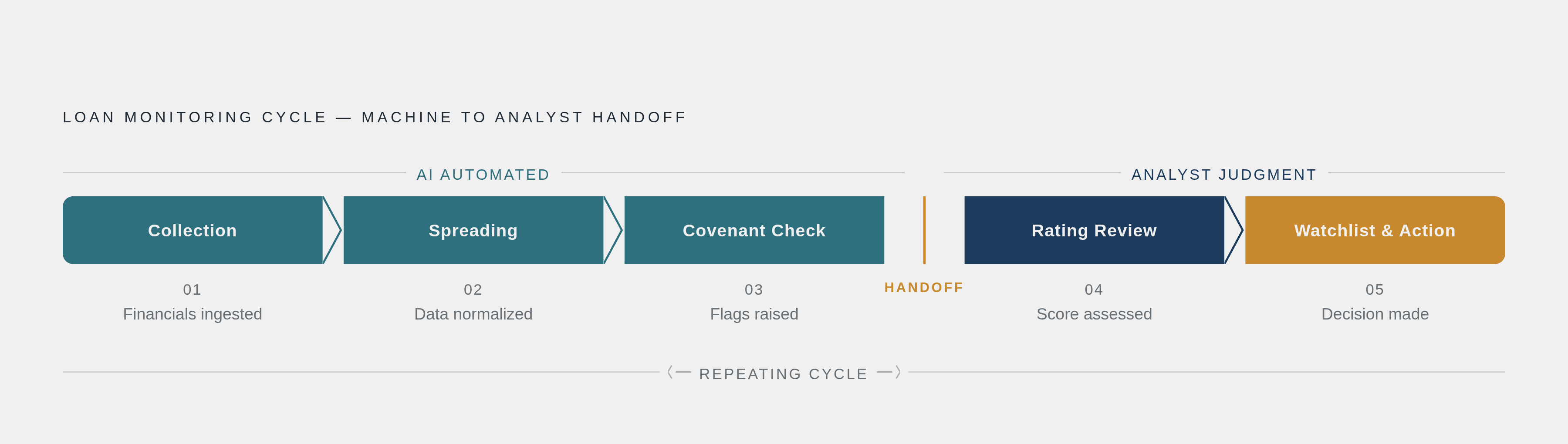
Picture the monitoring cycle as five steps that repeat every quarter for every loan: collection, spreading, covenant check, rating review, and then watchlist and action. AI can carry the weight of the first three. The last two belong to people. Any best practice described in the sections that follow, whether it's covenant testing, spreading quality, or portfolio-level intelligence, is really just an elaboration of where that handoff from machine to analyst needs to happen, and how fast.
Covenant monitoring as a continuous obligation, not a quarterly event
Most loan documents test covenants quarterly or annually. The financial inputs behind those tests, debt service coverage, leverage ratios, interest coverage, change monthly or even weekly as a borrower's business moves, so a test date can land months after the trend began. Testing only at the formal date means the credit team learns the result after a trend has already had three months to develop, which is too late to do much beyond react. One might argue that quarterly testing is simply how loan documents have always worked, and that's true. But the gap between when a document requires a test and when the underlying risk actually changes is a design flaw a monitoring program can correct, even if the legal documents themselves don't require it.
The better approach tracks trailing twelve-month figures continuously, so a manager watching the numbers sees a trend taking shape rather than discovering the final result on the test date. Early warning on covenants matters because a borrower can be paying on time and still be in default under the credit agreement, which payment-status monitoring alone would not catch.
The ICI's April 2026 guidance on valuation governance for private credit assets lays out three broad areas funds commonly focus on when monitoring: credit market conditions, portfolio company and investment or collateral performance, and covenant compliance. On the covenant side specifically, the ICI names leverage and interest-coverage tests, minimum liquidity levels, borrowing base availability, reporting covenants, and material adverse change clauses as the areas to track.
In practice, the cost of watching trailing twelve-month figures every month runs well below the cost of a surprise technical default discovered at quarter-end, after default interest has started accruing and a borrower conversation has to happen under pressure instead of ahead of it.
None of this works without a paper trail. For every covenant test, the record needs to show the source documents that fed the calculation, the calculation itself with its inputs and formula, the borrower-reported value, the threshold set in the credit agreement, the disposition (compliant, exception, breach, or waived), and the name of the person who signed off. AI-assisted covenant monitoring can take a DSCR calculation built from a trailing twelve-month rent roll, a task that used to run several hours by hand, down to minutes, and shift breach detection from something caught after the fact at quarterly review to a pre-breach alert the moment a threshold starts closing in.
Financial spreading as the foundation of reliable downstream monitoring
Covenant tests and portfolio dashboards are only as good as the spreading process that feeds them numbers in the first place, and spreading in private credit is a harder problem than it looks from the outside. Borrower financials arrive in whatever form the borrower happens to use: PDFs attached to an email, Excel files with a chart of accounts that doesn't match last quarter's, borrowing base certificates and compliance certificates built on templates nobody standardized across the portfolio.
Financial spreading, the work of pulling structured data out of all that unstructured material, has no real counterpart in private equity monitoring. That's part of why tools built for private equity monitoring tend to struggle when applied to credit operations: the underlying data problem is different in kind, not just in degree.
Manual re-keying is where the real damage happens, because an error made at the spreading stage doesn't stay contained to that one number. A spreading mistake in period one becomes a covenant calculation error in period two, and from there it can ride straight into a risk rating or a fund-level report without anyone catching it. The fix is spreading that standardizes borrower data in a form that feeds covenant tracking and risk alerts directly, so spreading functions as the entry point of the monitoring loop rather than a standalone task someone finishes and moves past.
Every extracted figure needs to trace back to the document it came from, and that's not only about satisfying an auditor later. A credit professional reviewing a flagged covenant needs to check the underlying number quickly, without re-running the extraction from scratch to confirm it's right. Source-cell traceability belongs at the top of the requirements list, not somewhere down near the convenience features: a covenant calculation that can't be traced back to its source document has no business in a credit committee presentation or an LP report.
Portfolio-level intelligence versus loan-by-loan surveillance
Everything described so far operates at the level of a single loan: spread it, test its covenants, rate it, decide whether it belongs on a watchlist. A program that does all of that well for every loan in the book can still miss the risks that only become visible when the book is read as a whole. Concentration in a single sector, correlated exposure across borrowers who share a supply chain, a cluster of maturities landing in the same eighteen-month window. None of that appears in a single loan file, because the risk only becomes visible when the loans are read together as a portfolio.
Without a way to compare risk consistently across the portfolio, teams default back to loan-by-loan review, and portfolio-level risk builds up unnoticed in a pile of individually clean-looking files. A fund can look completely healthy loan by loan while carrying a structural vulnerability, like heavy concentration in one sector or one vintage, that becomes visible only when someone looks at the book as a whole.
The FSB's May 2026 report describes a version of this problem at the regulatory level. If regulators are squinting at cross-portfolio concentration from the outside, fund-level teams have even less excuse to skip that view from the inside, where the data actually sits.
Benchmarking against something outside the fund's own book has become standard industry practice for testing whether an internal risk view actually holds up. Indices like the Stout Private Credit benchmarks, the S&P Lincoln Senior Debt Index Series, the Cliffwater Direct Lending Index, and the FTSE StepStone Global Private Market Indices give a fund something to check its own numbers against. Independent credit intelligence, meaning outside views on borrower quality for names that are unrated or entirely private, remains a real gap even at institutions whose internal monitoring stack is otherwise strong.
Portfolio-level intelligence isn't only about catching risk earlier. A book monitored at the portfolio level can flag concentration and diversification gaps automatically, on the same cadence as the risk alerts.
The tech stack that supports a strong monitoring program in practice
No single platform does all of this. The most common mistake in building a monitoring stack is treating every vendor pitch as though it covers the same ground, when a system of record, a document extraction tool, a credit intelligence feed, and a borrower-level monitoring tool are four distinct jobs, and each one fails in its own particular way when the wrong tool gets slotted into it.
The phrase "private credit monitoring software" actually hides two separate purchasing decisions. Treating those as one purchase instead of two is how budgets get wasted and how gaps open up between what gets monitored at the loan level and what gets reported at the fund level.
Each layer breaks differently when something goes wrong. A credit intelligence feed that isn't integrated at the borrower level is just noise competing for attention. An AI tool pressed into service as a system of record, instead of as a query layer sitting on top of one, turns into an audit problem the first time someone asks where a number came from.
Four kinds of tools actually touch monitoring, and each does a different job. The system of record is the single hardest piece of the stack to replace once a fund's entire book lives inside it, which makes the initial platform choice the most consequential decision in the whole setup. Custom agents built on general AI APIs handle the coordination work: chasing borrowers, drafting watchlist memos, answering quick questions about the book. They're genuinely useful for the administrative load that eats an analyst's week, but they should never be mistaken for the system of record itself.
Credit-native platforms are built around a fixed data model from the start: covenant fields that expect amendments, facility and tranche structures, rating workflows that assume a certain shape to the data. When a book's actual loan documents don't fit that shape, because covenant packages were negotiated deal by deal and don't follow a template, teams fall back on spreadsheets to patch the gap, and the single source of truth the platform was supposed to provide stops being single. Check this before signing any platform contract: does the data model bend to match covenants as they were actually negotiated, or does it expect covenants to match the model? A rigid system, asked to hold a heavily negotiated book, breaks exactly where the negotiating happened.