Spreading Consistency and Policy Compliance in Credit Teams
Standardizing how analysts spread financials keeps credit decisions consistent.

Spreading consistency is the foundation of credit policy compliance. Differences in period cutoffs, add-back treatments, and ratio formulas shape a credit decision before anyone writes an opinion. The most direct way to reduce variation across analysts, branches, and loan types is to make spreading an enforced, institution-specific standard, then preserve that standard through underwriting and post-close monitoring.
Why spreading is where credit policy actually breaks down
Credit managers often look for inconsistency in the memo or the committee discussion, where differences become visible. Yet the divergence almost always begins in the spread. Spreading maps income statement, balance sheet, and cash flow data from borrower documents into the institution’s standardized template, normalizing figures across years and entity types. Every ratio and recommendation downstream inherits those choices.
Inconsistent spreading thus stems from how the work is set up, even when analysts do it with care. When rules remain implicit, branch-to-branch differences in DSCR calculations and risk narratives are predictable. Two careful analysts can follow the same policy document while making different assumptions underneath it. Scorecard tuning, memo templates, and approval routing then address the symptoms. They cannot reconcile inputs that were defined differently before the analysis began.
What the spreading decision actually covers and where policy ambiguity hides
A spread is a chain of small policy decisions. At the income statement layer, gross revenue, COGS, operating expenses, EBITDA, depreciation and amortization, interest expense, and net income before and after taxes must be sourced and reconciled. Normalization then determines which reported figures represent ongoing performance. Uptiq’s spreading reference lists depreciation, officer compensation, one-time items, and owner distributions as areas where an analyst must use judgment. Depreciation is typically added back as a non-cash expense, while officer compensation requires a market-rate judgment and one-time items require judgments about materiality and recurrence.
A sole proprietor uses Schedule C, a partnership uses 1065 with K-1s, an S-Corp uses 1120-S, and a CRE investor LLC uses Schedule E. Each presents a different source for the DSCR numerator and different interpretation challenges. Global cash flow then combines related entities and personal guarantors, a full-day task manually, where assumptions about intercompany balances and passive-versus-active income can accumulate.
Even choosing the authoritative document is a policy decision. An audited statement and a management account may conflict, as may a filed tax return and a draft. Without a written source-of-truth hierarchy, each analyst resolves that conflict independently. The ambiguity precedes the arithmetic.
How spreading variation propagates into every downstream credit output
A normalization difference does not stay inside its spreadsheet. If two analysts treat officer compensation differently, their memos can present materially different risk framing for otherwise comparable files. Debate over the framing then diverts the committee’s attention from the deal. A scorecard cannot repair this divergence, because an identical DSCR formula produces different results when its numerator was assembled differently.
One analyst may classify a missing guarantor statement as a documentation exception, while another treats it as a policy exception. Those categories have different reporting consequences, so portfolio summaries can understate risk in one place and overstate it in another. Comparing scorecard outcomes with actual approvals can expose drift between policy intent and frontline practice. It reveals the symptom, however, without necessarily identifying the spreading choice that caused it.
Traceability is where the problem becomes harder to defend. An analyst may paraphrase a number from the spread without returning to the underlying tax return or financial statement. The number may be correct, but a reviewer cannot reconstruct its basis. By the time an examiner asks, a sound calculation and an unsupported assumption may look uncomfortably alike.
Why CRE lending compounds the spreading consistency problem beyond C&I norms
CRE widens the document stack before analysis even begins. Rent rolls, operating statements, tax returns, bank statements, appraisals, leases, and entity documents arrive in mixed PDF, Excel, and scanned formats. Each requires extraction and normalization. Compared with C&I, this variety gives analysts more opportunities to resolve equivalent information differently.
A property may sit in one entity, the operating business in another, and the guarantee with an individual. Each needs a separate spread before the lender can assemble a global cash flow view. Passive-versus-active income distinctions make that consolidation more than addition. Without common rules, the combined result embeds each analyst’s interpretation of the relationships.
The fragmentation also persists after the loan closes. Underwriting information does not reach asset management on its own, and covenant terms can stay in loan documents without being used for monitoring. Operational teams then review information that others have already checked. A lender can underwrite rigorously and still face manual reconstruction at the first review cycle because the structured data did not follow the loan.
What enforced, institution-specific spreading rules actually look like
The constructive response begins by separating templates from rules. A shared template controls headings, but it does not determine what belongs beneath them or how a reported figure becomes a normalized one. Enforced rules specify the required periods and their order for each loan type. They also define non-recurring item criteria and materiality thresholds, owner compensation benchmarks, intercompany balance treatment, related-party transaction handling, and debt schedule reconciliation. A template is the filing cabinet.
A written hierarchy says to use audited statements over management accounts and filed tax returns over drafts. Exception naming then replaces personal habit with a consistent distinction between documentation gaps and policy departures. Approval authority completes the chain by defining who can approve at each risk level and which exceptions require senior review.
Repeatability is the practical test of this foundation. The same borrower financials should produce the same standardized analysis regardless of which analyst, branch, or loan officer opens the file. This does not require identical credit opinions.
How AI spreading enforces rules consistently where manual processes cannot
Manual spreading makes adherence vulnerable to workload and deadlines. Analysts still fill in the section headings, but they can take less care with normalization as their queues grow. The policy has not changed. Its application has changed. Consistency depends partly on capacity as well as on the institution’s standard.
AI spreading can use the same mapping and normalization logic for PDFs, Excel files, and scans. That makes it an enforcement mechanism as well as a faster way to enter numbers. The essential condition is institutional specificity. A horizontal extraction tool supplies generic logic, while an institution-specific spreading layer applies the lender’s officer compensation benchmark, one-time item threshold, period alignment, and entity-type treatment rules. Reducing repeated data entry and formula checking lets analyst review concentrate on exceptions and credit judgment.
A medium-risk label without the income statement spread, DSCR calculation, and add-back logic gives an analyst too little to answer a committee question. The calculation must remain open to inspection. Explainability and human review must be built into the enforcement model from the start of automation.
Why spreading consistency must extend into post-origination covenant monitoring
The original spread remains useful after the credit decision. It establishes the definitions against which later performance can be compared, but only if monitoring uses the same normalization logic. Otherwise, a ratio may change because the method changed even if the borrower stayed the same.
At most institutions, covenant tracking lives in a spreadsheet that one person updates once a quarter. Problems are identified when the lender notices them, after the ratio first moves. Current payments do not rule out a breach. A technical default can exist while every payment is current and can trigger cash sweeps, default interest, or an accelerated loan.
Using the original spreading engine for recomputation turns the work into a portfolio-level exception queue. Compliant cycles pass through silently, while analysts open the files where the ratio moved. The shared definitions make that comparison meaningful. Maturity and refinance surveillance belongs in the same system, which should track loans within a defined forward maturity window, the projected proceeds under current underwriting, and the equity gap. Those signals give the portfolio team more time to act than a quarterly manual review does.
What the SR 26-2 guidance means for AI-assisted spreading and monitoring workflows
The Federal Reserve, OCC, and FDIC replaced SR 11-7 with SR 26-2 on April 17, 2026. The guidance, issued by the OCC as Bulletin 2026-13, also supersedes SR 21-8. Its scope is important to distinguish from the broader AI discussion. It applies risk-based principles to traditional statistical and non-generative, non-agentic AI models, while explicitly excluding generative and agentic AI.
That exclusion is not a legal exemption for generative tools used in spreading, memo generation, or covenant analysis. It leaves those tools outside this guidance’s scope rather than relieving lenders of responsibility for their use. Source citation, formula transparency, and analyst override capability remain basic requirements for defensible credit workflows. A regulated team needs to show how it reached a conclusion.
The guidance is non-binding and most relevant above a certain asset threshold, with materiality-based principles applied proportionally. Smaller institutions still have to answer examiner questions about model validation and audit readiness, with those questions scaled to their risk profile. For spreading, the governance implication is clear. Neither an unexplained score nor a consistent but unreconstructable calculation supplies the evidence needed to defend a credit decision.
The five controls a credit team needs to make spreading the enforced foundation of compliance
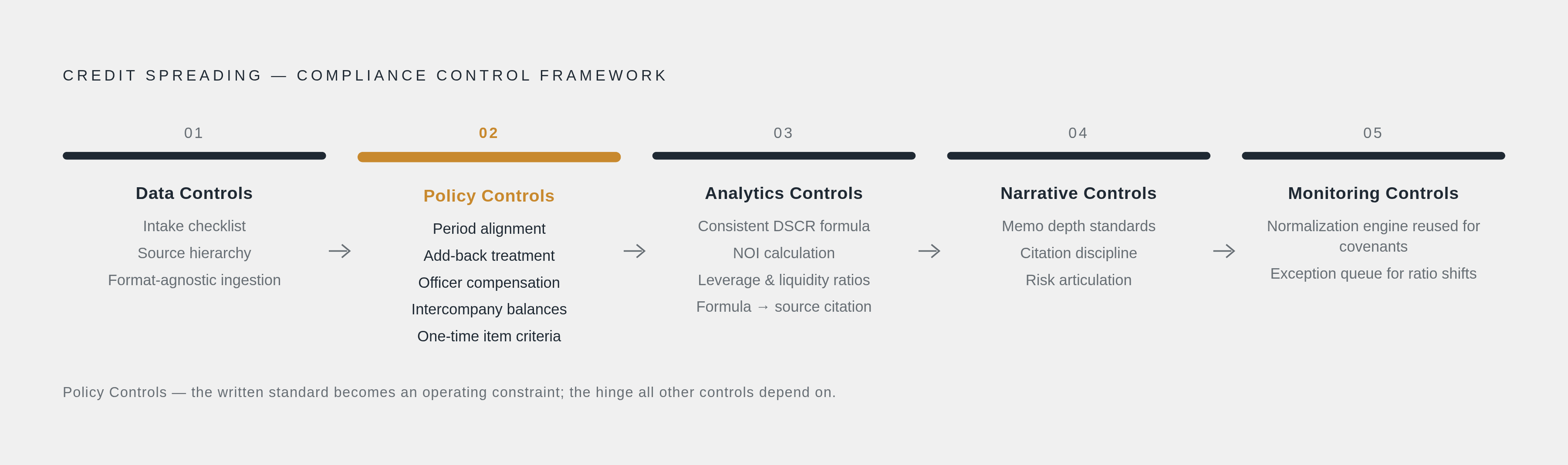
The practical framework for credit managers consists of five connected controls, beginning with data controls. A common intake checklist should cover financial statements, tax returns, bank statements, rent rolls, AR/AP aging, covenant documents, entity documents, and guarantor information. A written source-of-truth hierarchy resolves conflicts among those files. Format-agnostic ingestion keeps delivery format from changing normalization logic. These controls govern what enters the analysis.
Policy controls govern the choices made inside it. Period alignment, add-back treatment, officer compensation benchmarks, intercompany balances, and one-time item criteria need explicit written rules. Those rules must be explicitly enforced by the system producing the spread. Otherwise, policy remains dependent on analyst memory. This is the point where a written standard becomes an operating constraint.
Analytics controls make the calculations both consistent and inspectable. The same DSCR formula, NOI calculation, and leverage and liquidity ratios should apply across analysts, branches, and loan types. Formula transparency must connect each figure to its source document, page, and line item. Agreement on the answer is not enough. Reviewers need to reconstruct the calculation without relying on the person who first prepared it.
Narrative controls set the rules for how that analysis is shared with decision-makers. Shared standards for memo depth, citation discipline, and risk articulation should ensure that the same evidence gets much the same treatment. The underwriter is still responsible for the credit judgment, recommendation, and narrative voice. Standardization stops at the analytical foundation. A consistent spread supports professional disagreement by distinguishing differences in judgment from differences in arithmetic.
Monitoring controls preserve the foundation after the loan closes. The origination normalization engine should also support covenant recomputation, keeping current and underwriting-baseline ratios on the same definitional ground. The exception queue can then surface files where something actually changed. Together, these controls hold only when the spreading layer applies the institution’s own credit policy and every output remains traceable to its source. That integration turns compliance from a person-by-person habit into a lending standard that analysts, approvers, and examiners can reconstruct.