AI Readiness Assessment for CRE Lenders

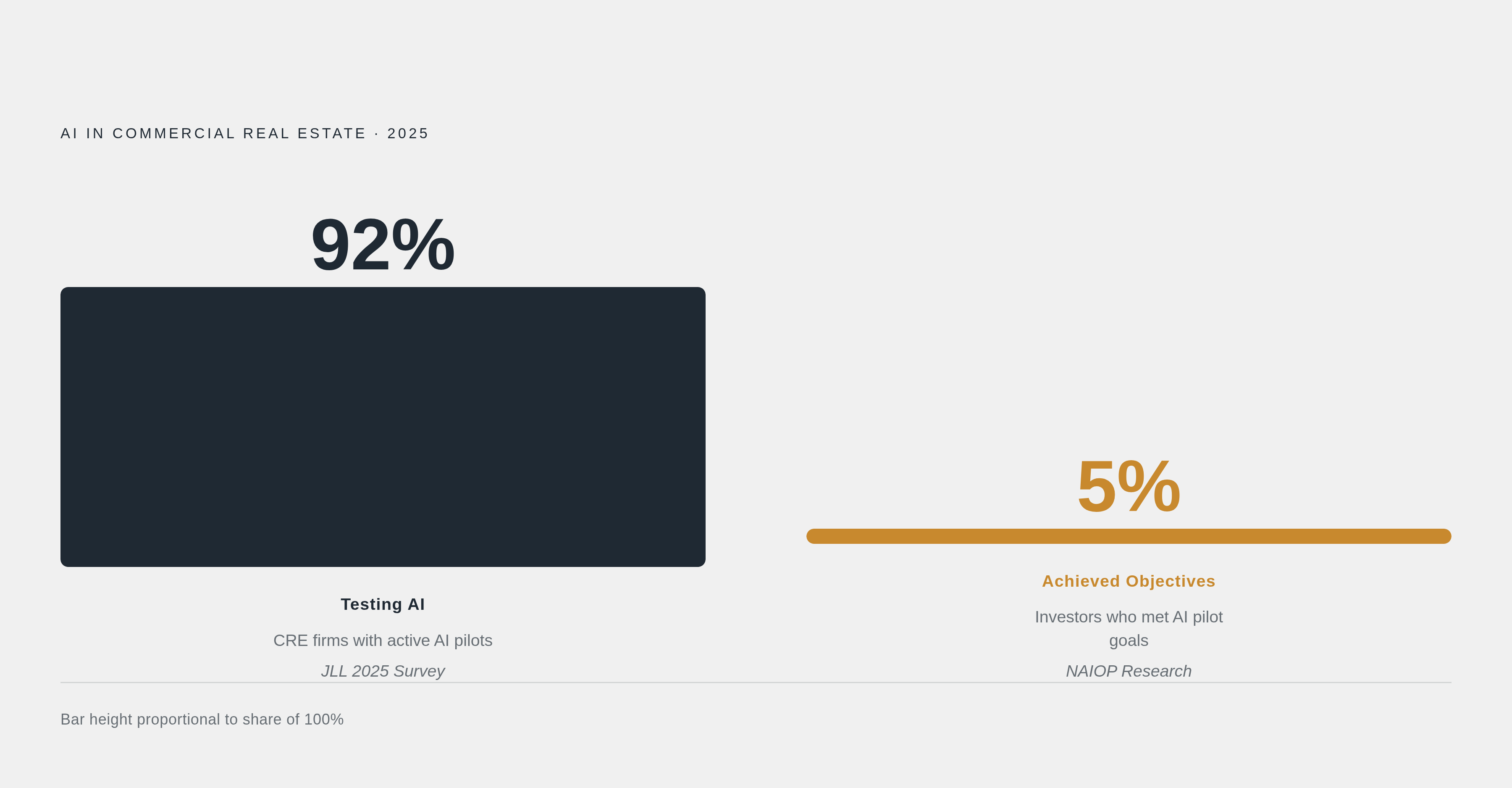
There is a version of this story that flatters everyone involved. Ninety-two percent of CRE firms are now testing AI, according to JLL's 2025 Global Real Estate Technology Survey. The press releases write themselves. The conference panels fill up. And yet NAIOP research shows that only 5% of investors who have started AI pilots have actually achieved their program objectives. Ninety-two percent experimenting. Five percent succeeding. That gap is not a technology problem. It is a readiness problem, and it is getting expensive.
The MBA projects commercial mortgage origination will reach $806 billion in 2026, up from $633.7 billion in 2025. Volume at that scale rewards lenders who can underwrite more deals per analyst hour and penalizes those who cannot. The competitive question is no longer whether to deploy AI. It is whether a lender has done the structural work that makes deployment viable. Most have not. A readiness assessment is how you find out where you actually stand.
What a Readiness Assessment Is Actually Measuring, and What It Is Not
A common misreading: readiness is not a catalog of licensed tools. A lender can hold active subscriptions across multiple AI platforms and still be functionally unprepared to deploy any of them in a live credit workflow. Licensing is procurement. Readiness is infrastructure.
What a readiness assessment actually measures is whether four operational dimensions, data quality and structure, workflow integration, security and compliance posture, and team capability, can sustain AI-generated outputs at production scale. Not in a sandbox. Not on a curated dataset. In the actual loan pipeline, with actual borrower documents, under actual regulatory scrutiny.
Each dimension has its own failure mode. A lender can be notably strong in one and disqualifyingly weak in another. That asymmetry is the point. The assessment's diagnostic value comes from identifying which dimension is the binding constraint, because addressing the wrong one first is precisely how pilots stall. Buying a better AI model when your data ingestion is broken does not accelerate anything; it just adds another subscription to the invoice.
The framework is not prescriptive. It does not tell you which vendor to buy or which workflow to automate first. It tells you where you are. That is a more useful starting point than most lenders currently have.
Data Quality and Structure: Whether AI Has Anything Reliable to Work With
CRE loan files are, by design, a normalization nightmare. A typical commercial loan file spans rent rolls, trailing twelve-month operating statements, tax returns, bank statements, appraisals, and entity documents, dozens of sources in formats that were never meant to speak to each other. Add owner-specific reporting conventions and multi-property aggregations, and you have a dataset that resists standardization even before AI enters the picture.
That is the first gate, and it is worth slowing down at. Are borrower financials arriving in machine-readable formats, or are they scanned PDFs that require manual re-entry before anyone, human or AI, can use them? Does the lender maintain a standardized chart of accounts that AI can map extracted line items to? How consistent are historical spreading templates across the loan book? What is the current error rate on manually spread financials, and is that rate tracked at all?
That last question tends to produce an uncomfortable silence. Most lenders do not track it, which means they have no baseline they are asking AI to improve upon.
There is a fraud dimension here that adds urgency beyond operational efficiency. AI tools now make it possible to generate complete, internally consistent CRE loan packages, rent rolls, T-12s, entity documents, that are structurally difficult to detect through manual review alone. With S&P Global estimating $1.26 trillion in CRE maturities peaking in 2027, the integrity of borrower-reported data is a credit risk question, not just a workflow question. AI-based anomaly detection, cross-referencing figures across documents and flagging structural inconsistencies, is a viable counter. But it only works if ingestion is machine-readable in the first place.
Lenders who cannot answer the ingestion consistency question have yet to start the data work that AI deployment actually requires.
Workflow Integration: Where AI Outputs Must Enter Live Decision-Making to Matter
Most stalled pilots share one structural trait. AI produces an output, a spread, a risk flag, a covenant summary, and an analyst then manually re-enters or re-checks it before it enters any actual decision. The manual workflow is preserved. The speed benefit is negated. The consistency benefit is negated. What remains is a more expensive version of the process that existed before.
That is the pilot trap. The question to ask is not whether AI is producing useful outputs, but where those outputs terminate. Do they feed directly into the underwriting model, or do they require analyst transcription? Do covenant alerts route automatically into credit review queues with citations to the source clause and the relevant financial statement page, or do they land in an email that someone will get to? Does portfolio risk update continuously, or does it still require a per-loan manual pull?
Commercial lenders using AI-powered underwriting report the ability to underwrite significantly more deals with the same team. Banks using AI underwriting are reporting substantial reductions in time-to-decision for commercial loans, per V7 Labs research. Automating P&L spreads compresses underwriting cycle times considerably. Those outcomes presuppose integrated workflows, not parallel ones.
But what if the outputs themselves are not trustworthy enough to act on without re-verification? That raises an important question about explainability. In regulated lending, AI that cannot show its reasoning cannot be used in credit decisions that face regulatory examination. Credit officers need to trace every AI-generated figure back to its source document. If the output arrives without provenance, the integration point does not matter, because the output is not usable.
Covenant Monitoring as the Highest-Stakes Integration Test
A mid-sized lender with 500 active commercial loans carries somewhere between 1,500 and 2,500 covenant thresholds each quarter, at a conservative three to five covenants per loan. Approximately 70% of banks still manage this through spreadsheets and manual processes. With $957 billion in CRE and multifamily mortgages that matured in 2025, and Moody's projecting U.S. office values down over 25% through 2025, the cost of a missed breach is not hypothetical. It is a write-down with a name attached.
Integrated covenant monitoring looks like this in practice: NLP extracts covenant terms from loan agreements and maps them to borrower financials automatically. Composite loan health scores aggregate DSCR trends, vacancy movement, tenant credit signals, and lease rollover concentration into a single, continuously updated indicator. Alerts route to the right person with a citation trail, the clause, the figure, the date of the trigger. Nothing requires a human to connect those dots manually.
The operational evidence is concrete. A $200 million CRE lender reduced monthly covenant review time from over 200 hours to under 30 hours after automation. Early alerts helped prevent two potential defaults, avoiding an estimated $1.2 million in write-downs. Those numbers deserve attention because they illustrate the difference between AI as an efficiency story and AI as a risk management story. The latter is where the real value sits.
One caveat every lender must assess candidly: a DSCR alert is only as reliable as the income data feeding it. A stale rent roll reflecting a departed tenant or an unreported lease modification produces a signal that does not represent current cash flow. Readiness here includes not just the monitoring system but the borrower reporting cadence and the lender's ability to validate incoming financial data against independent signals. The system can be elegant and the data can still be wrong.
The assessment question for this dimension is almost prosecutorial: does the lender's current covenant process generate an auditable record linking every breach determination to its source document, clause, and date? If the answer is no, the process will not survive regulatory examination, and that is true regardless of whether AI is involved.
Security and Compliance Posture: The Enterprise Gate Most Pilots Skip
CRE lending handles some of the most sensitive financial data that moves through institutional infrastructure. Borrower financials, personal guarantees, entity structures, tax returns, property appraisals: these documents flow through every deal, and when they pass through AI systems, the data governance question becomes immediate.
General-purpose AI tools not purpose-built for financial services may train on submitted documents, route data through third-party infrastructure, or lack the audit logging that regulatory examination requires. A lender that has deployed a generic AI tool without a data processing agreement and a documented model governance policy has not solved an operational problem; it has created a regulatory exposure and dressed it up as innovation.
The assessment questions here are specific. Does the lender have a documented AI governance policy covering data retention, model explainability, and output auditability? Do vendor contracts include explicit data processing agreements specifying that borrower documents are not used for model training? Is there role-based access control on AI-generated outputs, particularly covenant alerts and credit summaries, that matches the lender's existing information security architecture? Can the institution produce an audit trail from AI output back to source document for any credit decision that might face regulatory review?
Lenders who have not addressed this dimension are unready to deploy AI in production. They are running pilots that cannot scale to live credit decisions. The distinction matters, because the moment an AI-assisted output influences a credit decision that faces examination, the governance gap becomes a liability.
Team Capability: Whether Analysts Can Supervise AI Rather Than Be Replaced by It
The supervision problem is underestimated in most AI readiness conversations, and it shows up in a specific way. AI agents can orchestrate multi-step underwriting workflows: pulling data, running risk models, flagging anomalies, routing exceptions. But they require informed human supervision to catch errors and apply the contextual judgment that does not reduce to a pattern in training data.
An analyst who cannot interrogate an AI-generated DSCR calculation or question an anomaly flag is not a supervisor. They are a rubber stamp. That creates more risk than the manual process it replaced, because it adds a layer of false confidence to an output that no one actually checked.
A benchmark worth considering: a study involving BCG, Harvard, UPenn, and Michigan found that professionals using AI assistance completed 12% more tasks, finished them 25% faster, and produced outputs rated 40% higher in quality. But those gains accrued to professionals who could work with AI effectively, not to those who simply had access to it. Access is not capability. That distinction is where most capability readiness programs fail.
What capability readiness actually requires is more specific than "AI training." Analysts need to understand what the AI is doing well enough to know when its output is wrong, not how to build models, but how to stress-test outputs. Credit officers need to act on AI-generated portfolio signals without requiring a full manual re-underwrite to trust the number. Leadership needs to have defined where human judgment is required in the workflow and where AI output can be acted on directly.
It is also worth considering the institutional dimension here, not just the individual one. A team where senior credit officers distrust AI output because they were excluded from deployment will route around the tool regardless of how well it works. Readiness requires that the people closest to live credit decisions had input into how AI outputs are structured and presented. That is not a soft consideration. It is an adoption condition.
Scoring Where a Lender Stands: Translating the Four Dimensions into a Readiness Tier
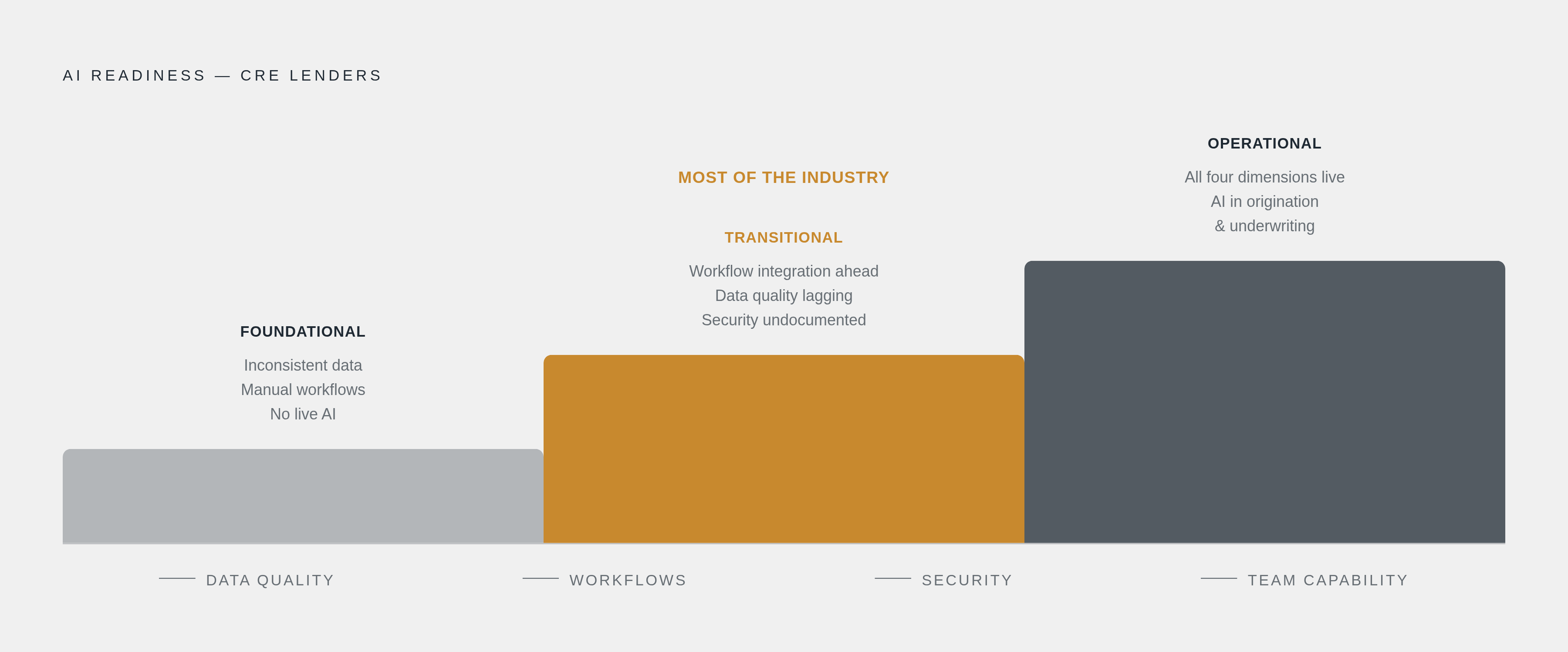
Three tiers describe where most CRE lenders actually fall, and the distribution is not flattering.
Foundational lenders have inconsistently structured data, manual workflows, undocumented security governance, and AI use limited to ad hoc tools with no connection to live processes. This tier is unready for production AI deployment in any core workflow. That does not mean AI has no role here; it means the structural prerequisites have not been met, and deploying production AI on an unready foundation accelerates failure, not success.
Transitional lenders, where most of the industry currently sits, have made progress in one or two dimensions. Workflow integration is often the furthest along, because it is the most visible and the most frequently targeted by pilots. Data quality and team capability tend to lag. Security posture is frequently undocumented entirely. This tier can demonstrate AI working in controlled conditions; it cannot scale to live credit decisions without addressing the remaining gaps. Being transitional is not a failure. Staying transitional because the gaps are invisible is.
Operational lenders have all four dimensions functional at production level. AI is embedded in origination, underwriting, and portfolio monitoring. Outputs carry audit trails. Teams are trained to supervise rather than defer. This is the tier that underwrites more deals per analyst hour, catches covenant breaches before they become defaults, and defends its AI-assisted credit decisions in front of regulators. The gap between this tier and the transitional tier is not primarily a technology gap. It is a readiness gap.
That distinction, between a technology problem and a readiness problem, is where this started. The lenders who close that gap first will not be the ones who licensed the most tools. They will be the ones who did the unglamorous structural work: cleaned the data, integrated the workflows, documented the governance, and trained their people to supervise rather than defer.
The 92% who are experimenting are not wrong to start there. But the 5% who have achieved their objectives did not get there by running more pilots.