CRE Lending Technology Stack Overview
How maturity waves and market stress demand better-integrated tech stacks.

The whiteboard conversation happens at nearly every lender. Someone draws boxes, connects them with arrows, labels the arrows "integration," and calls it a strategy. Everyone nods. The spreadsheets persist.
The more uncomfortable question, the one worth asking before anyone opens a vendor demo, is what it actually means to have a stack versus a collection of tools that happen to share a network. Most lenders, if they are being honest with themselves, have the latter.
The distinction is operational, not semantic. A stack implies that each layer does a defined job, that the layers communicate, and that a weakness in one layer degrades everything around it. A collection of tools implies each tool was purchased to solve an immediate problem, probably by a different person, in a different budget cycle, with incompatible integration assumptions. Those two things look similar on a whiteboard. They behave very differently under load.
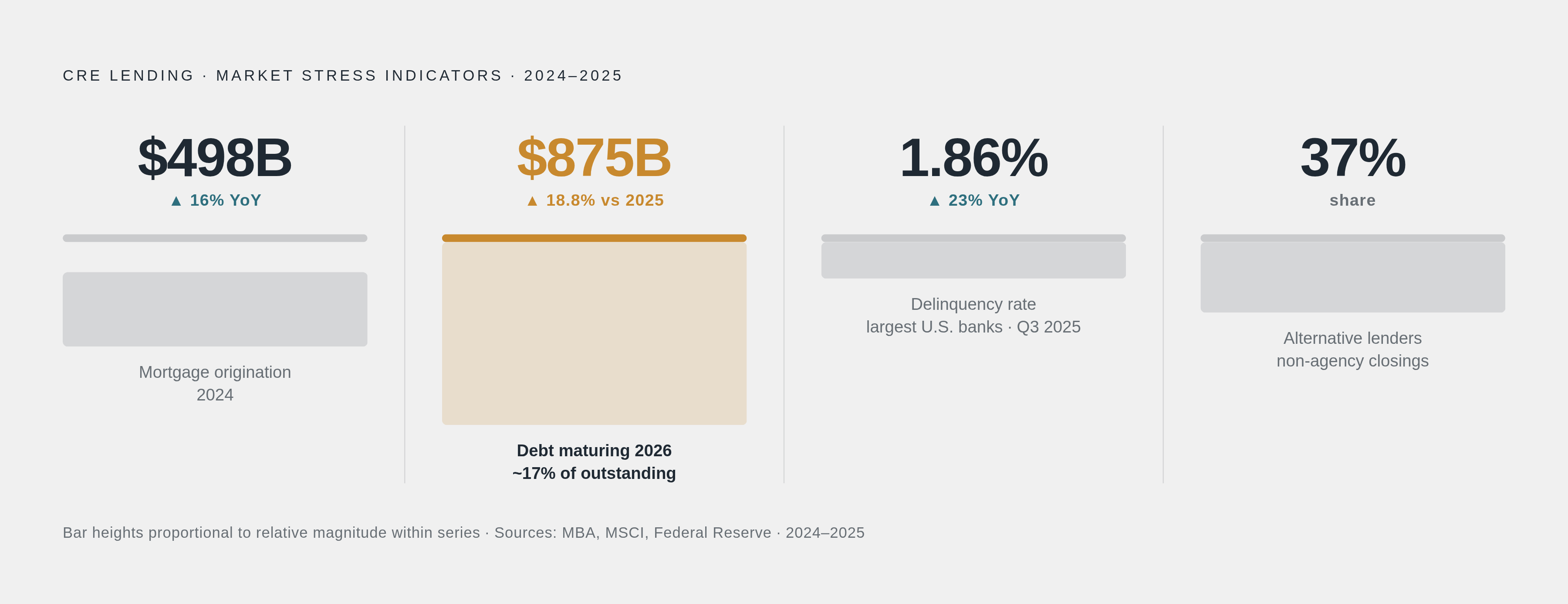
And the loading conditions right now are not background noise. CRE mortgage origination reached $498 billion in 2024, up 16% year-over-year according to the Mortgage Bankers Association. Roughly $875 billion in CRE debt matures in 2026, representing approximately 17% of the total outstanding commercial mortgage market and an 18.8% increase in maturities versus 2025, per S&P Global Market Intelligence. CRE delinquency at the largest U.S. banks hit 1.86% in Q3 2025, up 23% year-over-year per Federal Reserve data. Alternative lenders now account for 37% of non-agency loan closings. CMBS issuance reached $115.2 billion in 2025, the highest since 2007.
These numbers are not here to impress. They are here because they set the terms of the infrastructure problem. A stack dimensioned for the 2021 volume environment is not the same stack you want managing the 2026 maturity wave.
The layer-based framework that follows is diagnostic, not taxonomic. Four distinct functional layers exist in a mature CRE lending stack: origination, underwriting and credit analysis, loan servicing and portfolio management, and the data layer that feeds all three. A fifth thing, AI and automation, is not a layer at all. It is a cross-cutting capability embedded across all four, and treating it as a standalone procurement decision is one of the more durable misframings in fintech sales decks.
The failure mode to understand is cascading degradation. A strong origination system fed by poor property data produces fast, inaccurate decisions. Sophisticated portfolio monitoring built on manual servicing inputs produces unreliable risk signals delivered with unwarranted confidence. Speed and sophistication at one layer do not compensate for structural weakness at another. They amplify it.
Loan Origination Systems: The First Layer Actually Manages More Than You Think
The origination layer covers the span from application to close: collecting borrower documents, routing approvals through configurable workflows, reducing manual handoffs between origination and underwriting, and producing a structured loan file that downstream systems can actually consume. That last function is the one that gets undersold. The quality of the origination output sets the ceiling on everything that follows. Garbage in, garbage out is a cliché precisely because it keeps being true.
CRE origination is structurally more complex than consumer or standard C&I lending. Construction draws, complex collateral structures, multi-party deals, and product types spanning CMBS, bridge, and CLOs all require platform-specific capability. A general-purpose LOS handles CRE as one loan type among many. Purpose-built platforms are built around CRE's structural complexity as the primary use case, not an afterthought someone configured in.
Any modern LOS can handle CRE with sufficient configuration. That is technically true in the same way a flathead screwdriver can drive a Phillips screw: eventually, with enough effort, and usually at the cost of stripping the head. The configuration debt on a general-purpose platform serving complex CRE structures is real and compounds over time. It becomes someone's full-time job before long.
The platform landscape organizes meaningfully by lender type. Regional and large banks tend toward nCino, a cloud-based, Salesforce-integrated platform used by more than 2,700 financial institutions, with emphasis on compliance and risk monitoring across a broad product range. Finastra's Fusion Lending Suite covers multi-currency and ABL structures alongside CRE, used widely by large banks and credit unions for end-to-end origination through default management. Community and regional banks frequently run Jack Henry's LoanVantage, which supports construction lending specifically alongside its all-digital origination and underwriting workflow.
Institutional and specialty CRE lenders occupy a different part of the landscape. Rockport CORE is purpose-built for CRE and serves insurance companies, conduit lenders, GSE lenders, bridge and transitional lenders, B-piece buyers, and rating agencies, with over $1 trillion in active loans on the platform. RealINSIGHT covers the full lifecycle from origination and securitization through surveillance and dispositions, handling CMBS, Agency, bridge, construction, and CLO structures natively. These are not general platforms with a CRE module bolted on. The product complexity is load-bearing architecture.
The global loan origination software market is projected to reach $9.54 billion by 2030 at roughly 10.7% CAGR. That sustained investment is market confirmation, not speculative enthusiasm.
Underwriting and Credit Analysis: Where Data Becomes a Credit Decision
Underwriting in CRE requires simultaneous evaluation of two distinct risk dimensions: borrower creditworthiness and property performance. Most tools specialize in one or address both differently. Conflating them in a single workflow, without recognizing that distinction, is a reliable path to miscalibrated credit decisions.
Traditional CRE underwriting is document-heavy by necessity. Rent rolls, cash flow statements, appraisals, environmental reports, and borrower financials all arrive in varied formats, at varying quality levels, from sources with varying reliability. This is where AI has made its most defensible early entry into CRE lending: automating extraction and structuring of unstructured data so analysts spend time evaluating credit rather than reformatting spreadsheets.
Moody's Lending Suite for CRE automates data ingestion for rent rolls and cash flow statements, generates AI-assisted credit memos available immediately for analyst review, and applies machine learning for pattern recognition across property types. Kolena takes a different architectural approach: configurable AI agents built on natural language instructions tailored to a lender's own underwriting policies, with outputs that include citations for auditability. That auditability feature is not a nice-to-have. It is a compliance requirement, and platforms that treat it as an afterthought create downstream regulatory exposure for the lenders using them.
A December 2024 analysis of multiagent AI systems in banking found productivity gains of 20 to 60% for analysts applying AI to credit memo workflows, and roughly 30% faster credit decision turnaround. Some vendors report approval time reductions of up to 40% through AI-driven underwriting. That range reflects how much the outcome depends on document quality and workflow integration, not simply the sophistication of the model.
But what if the model is fast and wrong? That is the unresolved tension here. Model accuracy is bounded by data quality, and a fast, confident wrong answer is worse than a slower, calibrated one. The ceiling on underwriting quality is set not by the AI model but by the information it consumes. Which is why the data layer is not an afterthought.
Loan Servicing and Portfolio Management: Administering What's Been Closed
A distinction matters here that lenders frequently collapse. Loan servicing is loan-by-loan administration: payment processing, escrow management, covenant tracking, default resolution. Portfolio management operates one level of abstraction above that: risk concentration monitoring, regulatory reporting, real-time visibility across the book. Many lenders have one without the other. A meaningful number have both but with no functional integration between them, which produces a situation where the servicing system knows things the portfolio system doesn't, and the portfolio system reports numbers the servicing system never validated. This is roughly the infrastructure equivalent of having separate email accounts for the same job.
Finastra's Loan IQ is used by 21 of the 25 largest global banks and covers bilateral, syndicated, CRE, SBA, and specialty loans on a single platform. S&P Global's WSO Suite focuses on syndicated loan operations, CLO compliance, portfolio accounting, and secondary market trading. Both solve for the complexity end of the market.
Complex CRE servicing requirements, particularly for CMBS structures and multifamily portfolios under OCC and FDIC compliance frameworks, frequently lead large institutions toward outsourced servicing. MBA data from 2024 illustrates the scale: Wells Fargo at $646 billion in master and primary servicing, PNC/Midland at $584 billion, KeyBank at $478 billion, CBRE at $432 billion. Outsourcing is a legitimate stack decision. But it requires functional integration with the lender's internal portfolio management layer, or the risk visibility that portfolio management is supposed to provide simply does not exist.
Cloud-based solutions now represent more than 65% of new servicing implementations. On the portfolio management side, Built manages more than $317 billion in real estate dollars across 300-plus lenders and surfaces risk automatically while generating investor-ready reports. Purpose-built portfolio management platforms report reductions in manual data entry of roughly 90% through automated operating memorandum extraction, with quarterly reporting time cut by around 70%.
It is also worth considering where the maturity wall makes itself felt most acutely. The $875 billion in CRE maturities rolling through 2026 will spike monitoring workloads across the industry. Lenders without automated portfolio visibility will be managing credit stress by spreadsheet during peak stress, which is precisely when the spreadsheet has historically failed. A 2025 McKinsey report found more than 70% of small and regional banks in North America plan to upgrade their loan portfolio management system within two years, citing legacy systems' inability to provide real-time risk insight. The renovation is already underway. The question is whether it finishes before the wave arrives.
The Data Layer: What Feeds Every Decision Above It
No layer above this one functions better than the data going into it. Property valuations, market comparables, borrower history, and macroeconomic trends are inputs simultaneously at origination, underwriting, and portfolio monitoring. The data layer is not background infrastructure; it is the substrate on which every credit decision actually rests.
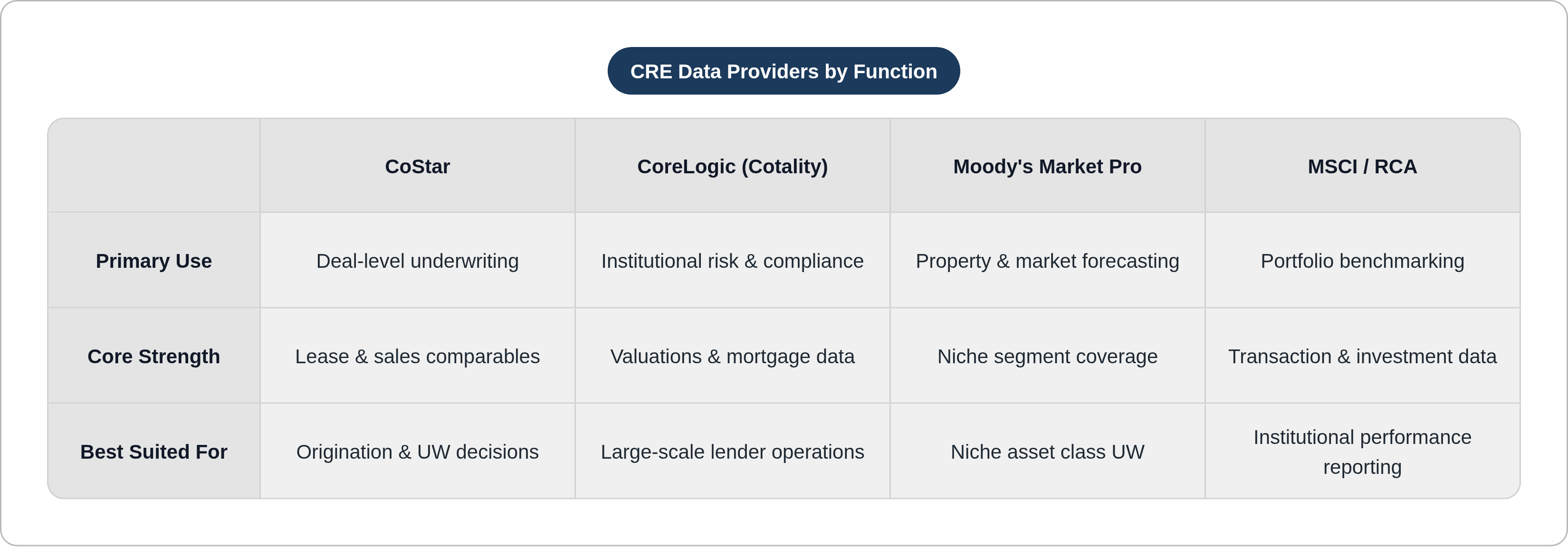
Major providers occupy distinct roles. CoStar provides lease comparables, sales comparables, and market analytics for office, retail, and industrial: the reference database for deal-level CRE decisions. CoreLogic, now operating as Cotality, has accumulated approximately 5.5 billion records over 50 years, with institutional-scale strengths in valuations, mortgage data, and insurance risk analysis. Moody's Market Pro covers property and market-level data including niche segments such as student housing, senior living, affordable housing, and self-storage, with economist-produced forecasts on rents, vacancies, and construction pipelines. MSCI, which acquired Real Capital Analytics, covers more than $50 trillion in transactions globally and over $2 trillion in private real estate assets, serving as the benchmark for institutional investment performance data.
Data selection is a stack decision with real consequences. CoStar and Moody's Market Pro serve deal-level underwriting. CoreLogic serves institutional risk and compliance functions at scale. MSCI serves portfolio benchmarking. Using the wrong provider for the wrong function does not produce a zero; it produces a plausible-looking answer that is wrong for the context it is answering. Those are harder to catch, which is the problem.
The regulatory stakes around the data layer changed materially in August 2024, when six federal agencies, including the CFPB, OCC, Federal Reserve, FDIC, NCUA, and FHFA, published an interagency AVM rule setting quality-control standards for automated valuation models, effective October 1, 2025. Lenders whose underwriting workflows rely on AVM outputs now have a compliance dimension to manage: data provenance, model governance, and output auditability are regulatory requirements. Vendors that cannot demonstrate compliance with these standards create downstream exposure for the lenders using them.
The data layer is also where AI model quality is ultimately determined. AI underwriting tools trained on thin, stale, or poorly sourced data produce confident, unreliable outputs. This is not a vendor problem to solve with a better algorithm. It is a lender problem to solve with better data infrastructure. The data layer is not the AI layer's support system. It is the binding constraint on what the AI layer can possibly produce.
AI and Automation as a Cross-Stack Capability, Not a Standalone Tool
The framing that AI is something to acquire, deploy, and extract value from is persistent and mostly incorrect. AI is embedded across every layer of a mature lending stack, doing different things at each layer. At origination: automated document collection, workflow routing, deal-stage tracking. At underwriting: rent roll extraction, credit memo generation, AVM integration, risk scoring. At servicing and portfolio management: automated covenant monitoring, risk concentration alerts, reporting generation. At the data layer: pattern recognition across transaction history, market forecasting, anomaly detection.
The construction lending use case is worth examining in some detail, precisely because it is granular. Built Technologies deployed an AI agent for draw request review, a process that has historically been slow, labor-intensive, and error-prone at scale. Reported results include draw approvals completed in as few as three minutes, a 400% increase in risk detection versus human-led reviews, 100% policy adherence, and 300% to 500% ROI on portfolios as small as approximately 500 loans. The specificity of the application is what produces the result. This is not a general automation layer. It is AI operating as a decision-support agent within a particular workflow, constrained by particular policies, evaluated against particular outcomes. The boundaries are load-bearing.
For alternative lenders applying AI trained on property transaction history, borrower exit strategy data, and local market velocity metrics, IFC estimated in 2024 that default rate reductions of 15 to 20% are achievable versus traditional LTV-only underwriting. The improvement derives from richer input variables, not faster processing. That distinction keeps returning us to the same place: data quality determines the ceiling.
The cost-structure implication compounds in a direction that is difficult to reverse. Institutions that have reduced per-loan processing costs by 30 to 40% through AI automation hold a structural advantage that widens with volume. The maturity wall in 2026 will process very differently through a lender with automated workflows than through one managing equivalent volume by hand.
Why exactly does this gap persist? McKinsey's July 2025 survey of North American banks found only 12% have deployed any generative AI use cases. The gap between stated interest and actual implementation is not primarily a technology gap. It is partly organizational inertia, partly data readiness, partly a procurement process designed to evaluate software that was not designed to evaluate AI systems embedded in complex workflows. The lenders closing that gap are not doing so because they found a better AI product. They are doing so because they resolved the layers beneath it first, and then gave the AI something reliable to work with.
That is the actual argument: not which AI tool to buy, but whether the stack beneath it is worth building on.