Build vs Buy for CRE Fintech Solutions
Buying beats building for underwriting and covenant tools most CRE firms admit.

"CRE fintech" gets used as a catchall, but it covers five or six different kinds of software wearing the same trench coat. There's deal sourcing software, document processing and spreading platforms, covenant and compliance monitoring, portfolio dashboards, and capital markets infrastructure for structuring and selling debt. Each sits at a different point on the risk spectrum, and where it sits changes the math entirely.
Build-vs-buy in commercial real estate fintech is a different question than the one a general counsel asks about e-signature software or a sales team asks about a CRM. It turns on whether a firm's workflows, risk appetite, and asset mix are too specialized for off-the-shelf tools, or too demanding for a custom build to survive past its second year. Here's the position this piece takes: for anything that touches underwriting or covenant risk, buying beats building far more often than CRE firms want to admit. Most of the reasons firms give for building don't survive someone actually running the numbers.
Most build-vs-buy frameworks treat this as a cost question: license fees against engineering hours, amortized over some tidy three-year window. That works fine for a project management tool. It falls apart here because the stakes go past money, since a tool that mishandles a rent roll or miscalculates a DSCR covenant costs a closed deal, or lets credit risk sit unflagged for three months past when it should have surfaced.
The market backdrop makes this harder to ignore. Proptech investment hit $16.7 billion in 2025, up 67.9% year over year, so the vendor field is growing fast and the off-the-shelf options are noticeably better than they were two years back. That should make buying easier. Instead it makes the evaluation harder: more vendors, more overlapping sales pitches, more pressure to just pick something and move on before the wall of loan maturities working through loan books right now gets any worse.
A tool that touches underwriting, risk scoring, or compliance carries a much higher cost of failure than a tool that formats a quarterly report or syncs contacts into a CRM. Get the reporting template wrong and someone reformats a slide. Get the covenant test wrong and a lender misses a DSCR breach that should have triggered a workout conversation months earlier. The framework has to bend depending on where in the stack a tool sits: workflow-critical systems deserve more scrutiny and less patience for improvisation, while productivity-layer tools can handle a lightweight internal build without much downside.
The highest-return AI applications in CRE lending for 2025 into 2026 cluster around underwriting automation: financial spreading, covenant monitoring, portfolio risk alerts. These are exactly the tools where fit to the domain matters most and generalist software struggles hardest. General-purpose AI models were never trained on offering memorandums, rent rolls, T-12 operating statements, or construction draw schedules with the specificity CRE underwriting demands. Ask a horizontal large language model to pull effective gross income off a rent roll with mixed lease structures, and it hands back something that looks right without actually being right. That gap is exactly where the case for buying gets strongest.
The real total cost of ownership on both sides of the ledger
Both build and buy get pitched with a sticker price that hides most of the real cost. The hidden costs take different shapes, but they do comparable damage, and pretending otherwise is how a firm ends up stuck with a bad decision three years too late to reverse cheaply.
On the build side, cloud infrastructure costs pile up as usage scales, not in a straight line but in a step-function way that catches finance teams off guard during budget season. Senior engineering talent runs $120,000 to $180,000 in salary as of 2025, DevOps engineers $130,000 to $190,000, and that's before benefits, before the cost of losing institutional knowledge when a senior developer takes a better offer somewhere else. Model validation, audit documentation, and the steady grind of compliance updates all sit outside the initial build budget and inside every budget after it. There's also a cost that never makes it onto a spreadsheet: every hour an engineer spends patching a covenant-tracking tool is an hour not spent on whatever actually makes the firm different from the one down the street.
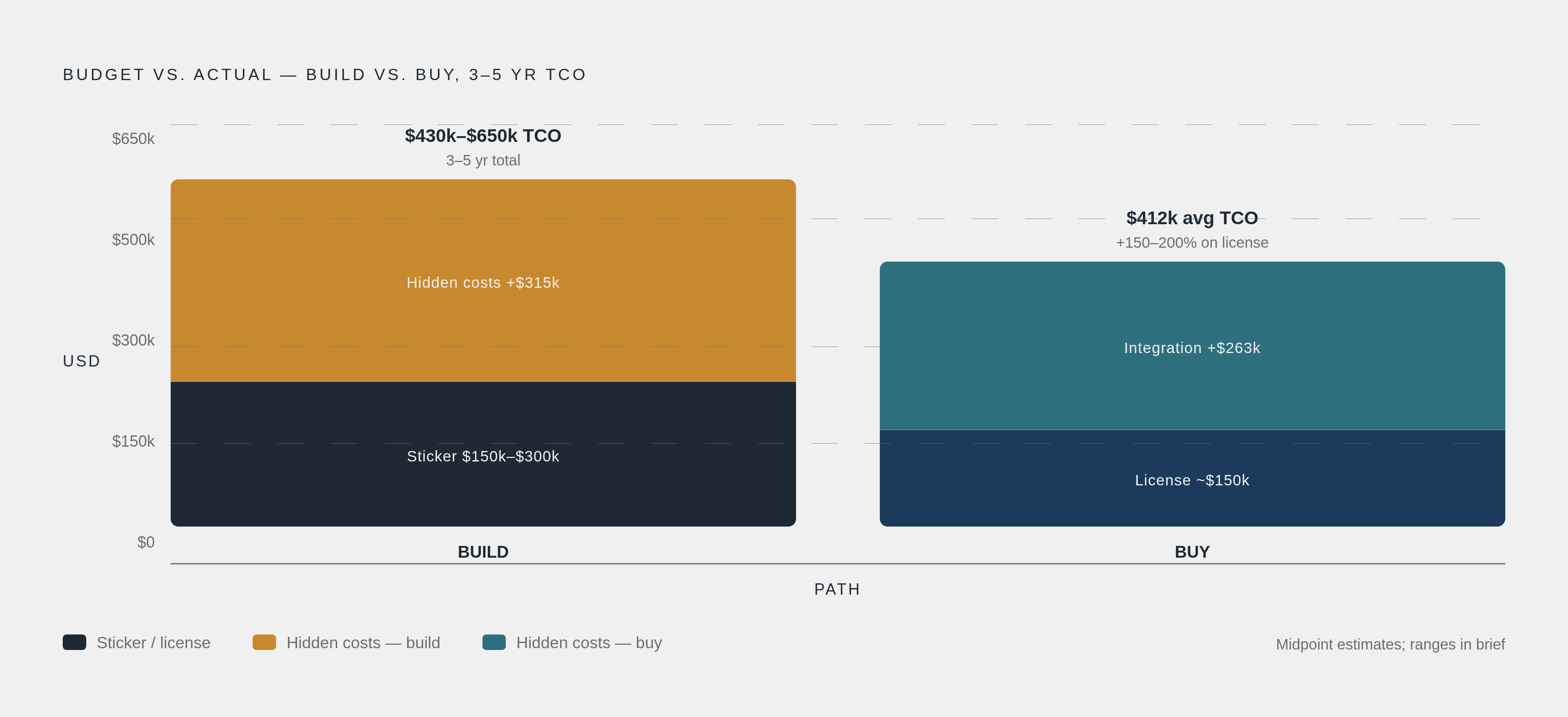
Buying has its own hidden layer. Hidden integration costs routinely add 150% to 200% on top of the license fee, a number that catches procurement teams off guard almost every time. Renewal periods bring rising prices, usage-based charges kick in once a firm actually scales adoption, and features that looked bundled in the sales demo turn out to carry add-on pricing once the contract gets signed.
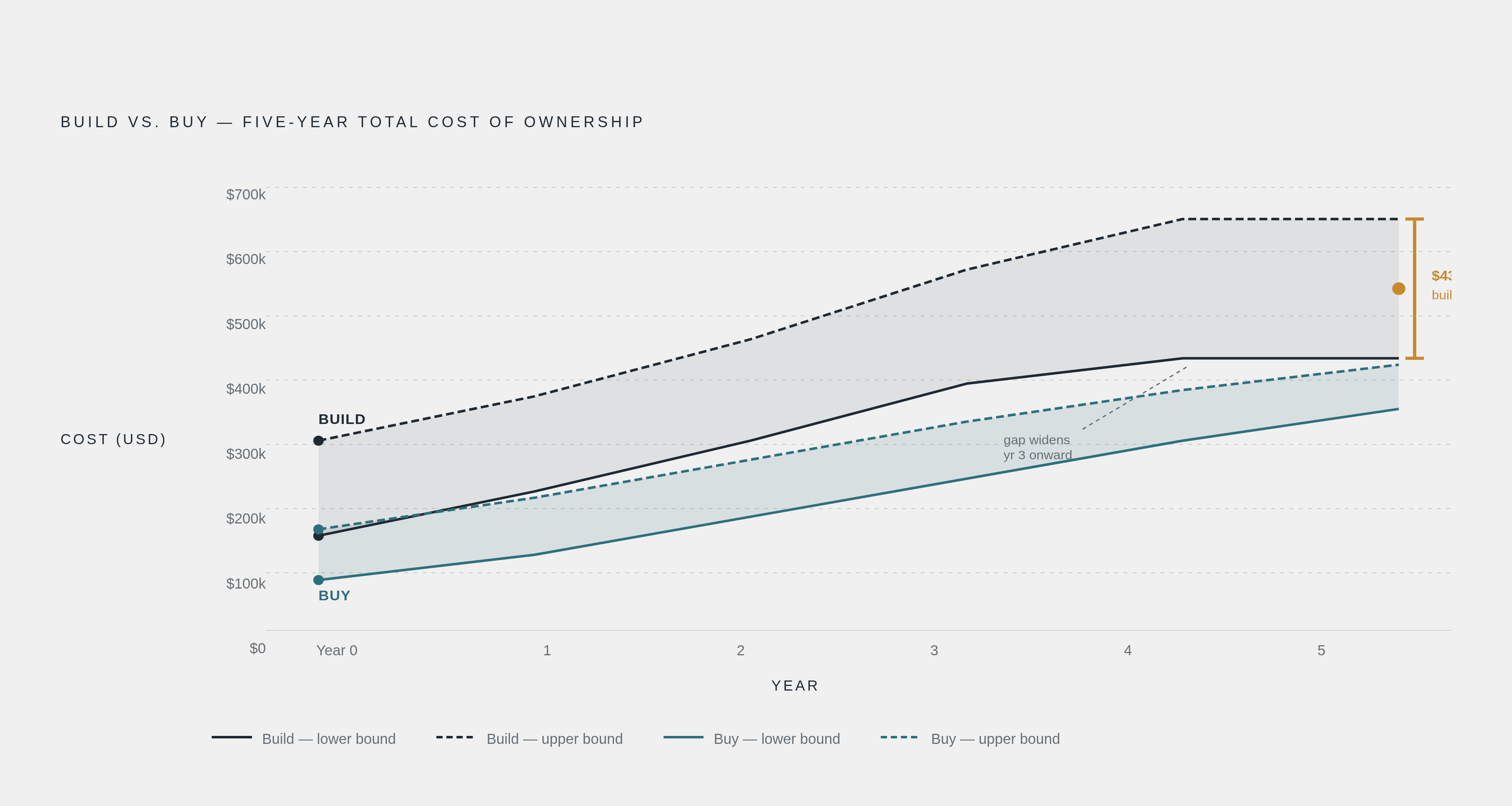
A useful comparison comes from compliance software more broadly: custom regulatory-compliance tools cost $150,000 to $300,000 to build initially, but rack up $430,000 to $650,000 in total cost of ownership once technical debt, staff turnover, and ongoing regulatory updates get counted. That's a substantial gap between sticker price and real price, and there's no reason to think CRE compliance tooling behaves any differently. The number on the invoice rarely matches the number that shows up three years later, on either side, and the only real defense is modeling both paths across a three-to-five year horizon before anyone signs anything.
Why the AI-accelerated build looks cheaper than it is
AI coding tools have genuinely cut the cost of building Version 1. Scaffolding a prototype, generating integration scripts, automating data transformations, all of it takes a fraction of the time it did five years ago, and that part is real. It has also set a trap: teams reach a working prototype in a few weeks and start treating it like production software, when a clean demo says nothing about what comes after.
The demo shows the first build, but it doesn't show the years after. The real cost of software has always been keeping institutional trust in that code over time, across staff turnover, across changing loan structures, across every audit and examination the tool gets pulled into. Version 1 doesn't include the security review, or the patching that follows it, and it doesn't include regression testing as CRE document formats and loan structures evolve, and they will evolve. It doesn't include the regulatory update cycle either: covenant definitions shift, DSCR calculation standards get revised, reporting requirements change, and someone has to rebuild the logic every single time. Ownership continuity goes unsolved too, since AI-generated code still needs a human who understands it and answers for it, and when that person leaves the firm, the institutional knowledge leaves with them, no matter how well-commented the code was.
A tech-enabled brokerage with a small engineering team can genuinely get most of the way to a working custom build. That only pays off, though, if the firm already has the infrastructure to build on top of, and the actual appetite to maintain the thing for five to seven years after launch, not just the six months after the demo gets applause in a partner meeting. For CRE lenders and asset managers, the harder question runs deeper than whether this can get built. Almost anything can get built, but whether the firm can keep it accurate, auditable, and current across a loan book that keeps changing shape underneath it is the question that actually decides this.
The six CRE-specific factors that actually settle the decision
Generic build-vs-buy frameworks list seven to ten universal criteria, most of which don't survive first contact with an actual CRE workflow. Six factors do the real work here.
Domain fit of the problem comes first. Does the workflow require reading CRE-native document types (rent rolls, T-12s, offering memorandums, construction draw schedules) at a level of precision that actually matters for a lending decision? General-purpose AI models weren't trained on multi-tier debt structures or property-level covenant compliance, and a custom tool built on top of a generalist model inherits that gap instead of closing it. This is usually the strongest signal pointing toward buying something purpose-built.
Integration with institutional IP matters just as much. A firm's underwriting templates, internal risk models, and covenant definitions are intellectual property in the fullest sense, not just data sitting in a spreadsheet somewhere. A tool that can't be grounded in a firm's own evolving methodology creates a two-system problem: the vendor's model running one way, the firm's actual underwriting judgment running another. Worth checking directly: can the vendor's platform ingest and run against the firm's own templates, or does adopting the tool mean quietly adopting someone else's schema instead?
Speed to deployment versus urgency is the third factor, and it's more concrete than it sounds. Custom builds typically run 6 to 18 months from kickoff to something usable; vendor deployments run 3 to 6 months. That gap matters enormously when $929 billion in CRE loans matured in 2024 and another $957 billion was projected to mature in 2025, according to Mortgage Bankers Association figures. An institution without scalable underwriting capacity right now loses ground every month the build drags on.
Ongoing maintenance burden and regulatory exposure is where a lot of build decisions quietly stall out. CRE lending sits inside a regulatory environment that shifts: examination standards change, covenant definitions get revised, reporting formats evolve. Every one of those shifts becomes an unplanned sprint for a custom build team, while a purpose-built vendor absorbs the update as part of a normal product roadmap. Audit trails and examiner-readable documentation aren't optional for regulated lenders, so it's worth asking honestly whether an internal build team can keep up that discipline for years, not just for the launch.
Portfolio scale and exception surface area is the fifth factor. A firm tracking a handful of loans can manage covenant compliance by hand, or with a lightweight internal tool, without much trouble. A firm tracking dozens or hundreds of loans across multiple asset types needs portfolio-level exception reporting in one place, a capability that gets structurally hard to keep alive in a spreadsheet or a homegrown tool once the loan count climbs. Scale is the multiplier here: the bigger the book, the further build and buy pull apart in practice, even if they looked about the same on paper at ten loans.
Strategic differentiation versus operational table stakes closes the list. A capability that's genuinely proprietary, say a risk-scoring approach built up over years that represents real competitive advantage, can justify building and defending it despite the maintenance cost. A capability closer to table stakes (spreading financials, tracking DSCR, generating pipeline reports) rarely produces a durable edge from a custom build, and mostly pulls engineering time away from work that would actually set the firm apart. Most CRE lenders and asset managers, when they're honest about it, find their underwriting infrastructure sits in the second bucket, not the first.
Where buying a purpose-built CRE tool has the clearest edge
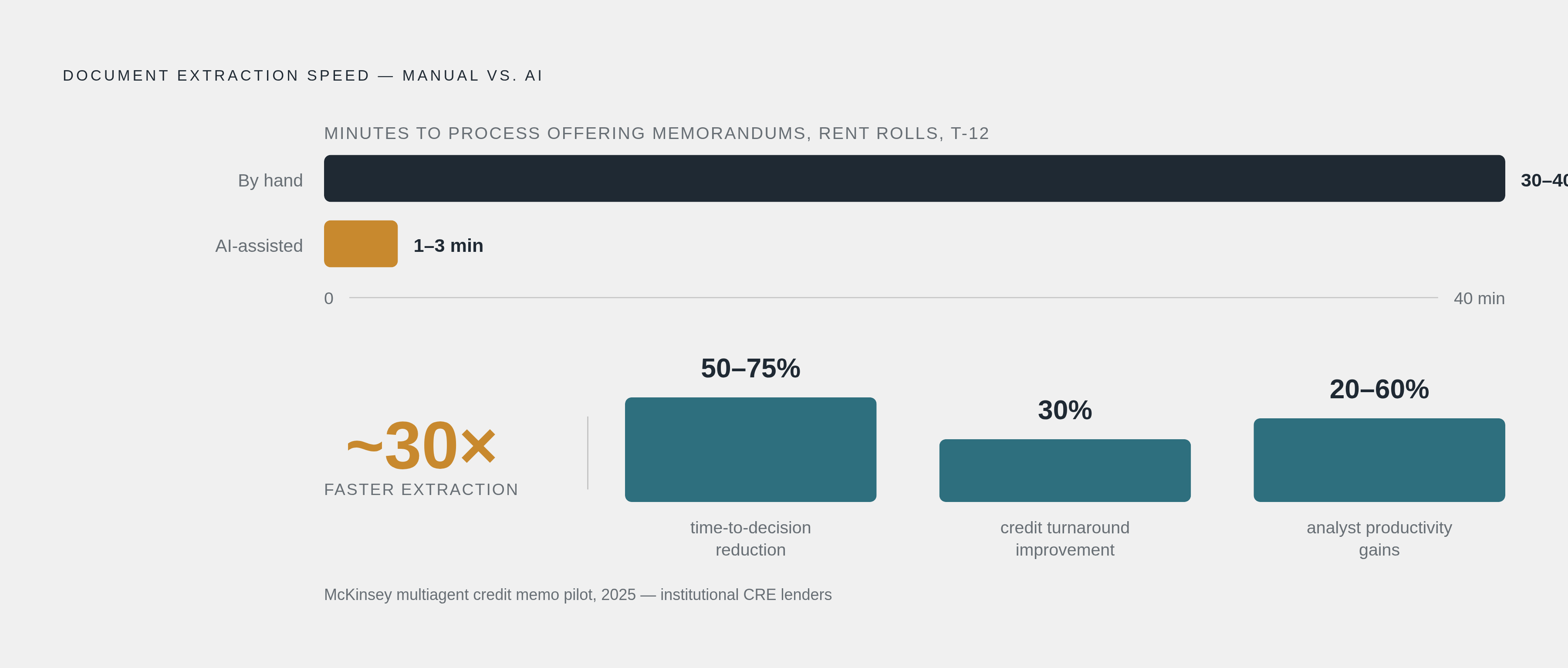
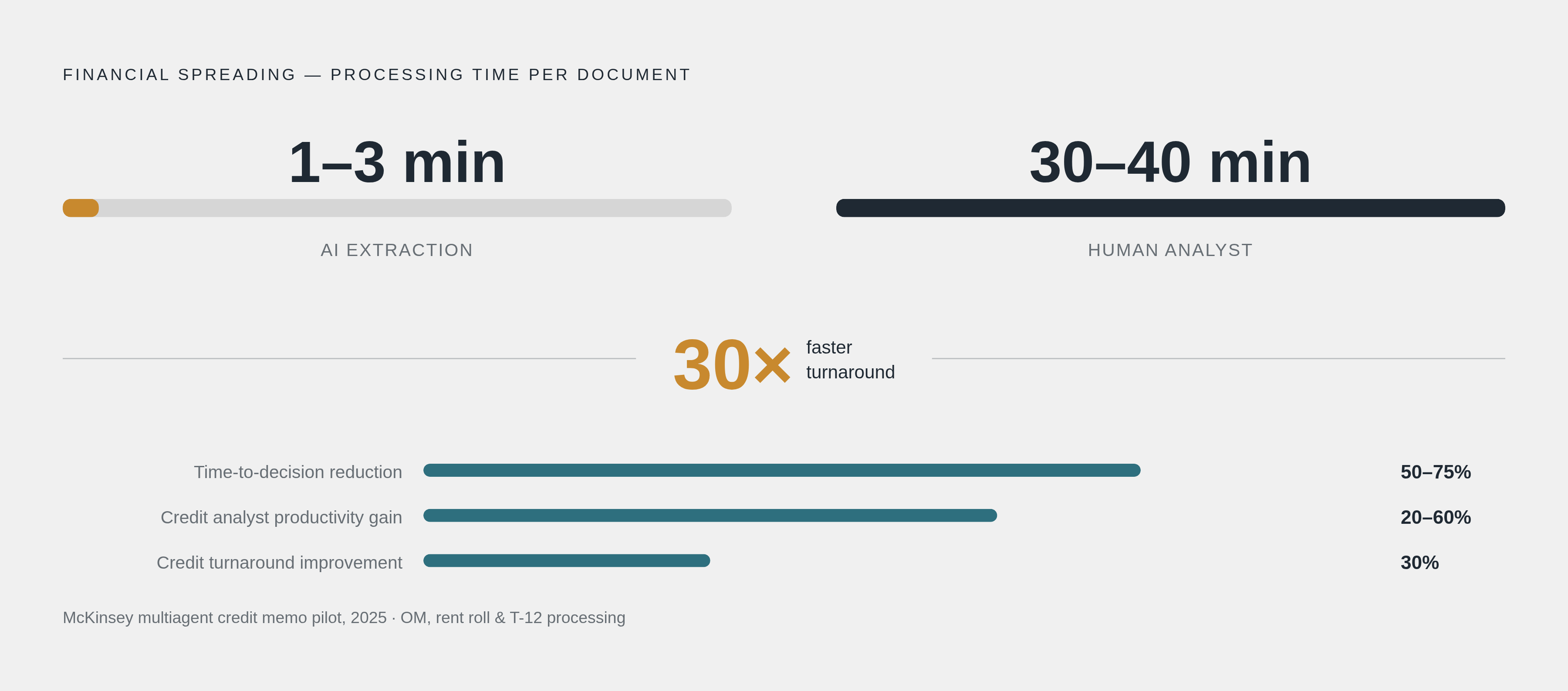
Financial spreading and underwriting automation is where the buy case is strongest, and it isn't close. AI-driven extraction tools process offering memorandums, rent rolls, and T-12 statements in roughly 1 to 3 minutes, against 30 to 40 minutes for a human analyst doing it by hand: a productivity gain in the range of 30x, documented in market research. Institutions using this kind of automation report 50% to 75% reductions in time-to-decision, and a 2025 multiagent credit memo pilot from McKinsey found a 30% improvement in credit turnaround time alongside 20% to 60% productivity gains among credit analysts. None of that works without domain-accurate extraction, though, since a generalist LLM won't reliably pull DSCR inputs or occupancy figures out of a real CRE rent roll without training specific to the format.
Covenant monitoring at portfolio scale is the second clear case. Testing DSCR thresholds, verifying construction draw compliance, confirming lease-up milestones across a whole portfolio needs automated testing against live financial data, not a separate spreadsheet maintained per loan by whichever analyst happened to inherit it last. CRE covenants tie to property-level performance in a way corporate loan covenants generally don't, so the monitoring tool has to understand asset-type-specific structures rather than applying one generic template across an office building, an apartment complex, and a self-storage facility. Purpose-built platforms with portfolio-level exception dashboards and auditable compliance records solve a problem that homegrown trackers tend to fail exactly when the portfolio gets big enough to need them most.
Portfolio opportunity surfacing rounds out the case. Refinancing windows, loan maturity alerts, covenant breach signals should surface on their own rather than through a manual deal-by-deal review, especially with $583 billion in CRE lending forecast for 2025. Reviewing a large loan book one file at a time is a structural liability at that volume, and purpose-built platforms built around portfolio intelligence can surface these signals across an entire book, where a custom build trying to replicate that logic has to keep rebuilding it every time loan structures and market conditions shift.
What separates a genuinely useful purpose-built tool from a merely well-marketed one comes down to a short list of concrete features. It should run against the firm's own templates and underwriting logic, rather than forcing adoption of a vendor's schema, and it should cite sources for extracted data, so an analyst can trace a number back to the page it came from instead of trusting output on faith. It should come from a team with actual CRE transaction experience, people who have sat across the table during a closing, rather than engineers who mapped the workflow secondhand. And given how sensitive CRE deal data is, real security architecture is a baseline requirement, not a bullet point on a sales deck.
Where building remains defensible, and the conditions that must hold
Building holds up when the workflow is genuinely proprietary and nothing in the vendor market touches it, full stop. That's a narrower category than most build advocates assume, but it's real.
It holds when a firm has built a genuinely unique risk model, a multi-factor underwriting approach or scoring method developed over years, that no vendor's schema could copy without flattening the thing that makes it valuable. It holds when the firm already has real engineering infrastructure and staff with actual CRE domain knowledge, so the marginal cost of the build is legitimately low rather than low in theory only. And it holds when the use case is narrow and stable enough that the maintenance burden won't compound the way covenant-tracking logic tends to compound once loan structures start varying.
A middle path splits the difference sensibly: buy the workflow-critical, document-heavy layer from a purpose-built vendor, and build custom integrations on top for whatever proprietary logic the firm isn't willing to hand over to anyone else's schema. That keeps engineering time for the work that's genuinely differentiated, and skips the trap of rebuilding CRE-native document processing from scratch just to prove it can be done in-house.
A few red flags suggest a build decision is happening for the wrong reasons. If the main driver is dodging a license fee rather than defending real strategic differentiation, that's a tell, and so is nobody having modeled the three-to-five year total cost of ownership, including developer retention and regulatory update cycles. A working prototype after a few weeks is not a maintained system after three years, and treating the two as the same is the trap from the section above, arriving right on schedule. As of mid-2025, only 12% of North American banks had deployed any generative AI use case at all. For most institutions, building from scratch adds another lap to run rather than a head start.
Making the decision stick: how to run the evaluation inside a CRE institution
The build-vs-buy call too often gets made informally, driven by whichever engineering lead has the loudest opinion in the room or whichever vendor demo happened to land the week budget got discussed. That's how firms end up locked into three-year commitments nobody actually modeled.
A cleaner process starts with naming, in writing, which of the six factors above actually carry weight for the specific tool under review. Not all six matter equally for every workflow, and a reporting dashboard and a covenant-monitoring engine don't carry the same weight on domain fit or regulatory exposure, so treating them as if they do just muddies the evaluation. From there, the three-to-five year TCO model needs to happen before any decision, covering both paths with the same rigor: developer salaries and turnover risk on one side, integration costs and renewal pricing on the other.
Whoever runs the evaluation should also stress-test the loudest argument in the room, whichever direction it points. An argument for building that rests mainly on avoiding cost rather than genuine proprietary differentiation needs to survive being written down next to the actual maintenance math, not just sound convincing out loud in a meeting. An argument for buying that rests mainly on a slick demo needs to survive a real test against the firm's actual document formats and actual underwriting templates, not the vendor's sample data.
This process won't guarantee the right answer every time, but it does force the decision to answer to something sturdier than whoever argued loudest. Given how much a bad tooling call can cost in a business built on document-heavy, time-sensitive deals, that's a fairly reasonable bar to insist on.