NAV Calculation Methodologies for Private Credit Funds
Disciplined inputs and traceable judgments separate defensible NAVs from arbitrary marks.

Private credit NAV calculation is simple arithmetic built on difficult estimates. For CRE professionals, the central question is not whether a fund can subtract liabilities from assets, but whether its loan valuations, accruals, and supporting records justify the result. A defensible NAV depends on disciplined inputs and a process that makes each judgment traceable.
Why NAV in private credit is an inputs problem, not a formula problem
The operative formula is NAV = Total assets at fair value − Total liabilities − Accrued expenses. A mutual fund marks to exchange prices daily, but a private credit fund must build fair value for its loan positions from models, manager judgment, and third-party review. The inputs are built, not looked up. That distinction puts the analytical burden upstream of the calculation, where an apparently precise number may rest on uncertain assumptions.
For CRE professionals, that uncertainty is close to home. CRE loans are almost universally illiquid, collateral-dependent, and sensitive to changes in borrower credit. A valuation error therefore cascades into LP capital account allocations, management fee calculations, performance reporting, and regulatory filings.
The five input categories that make up a private credit NAV
Asset valuations are the dominant input and the primary source of judgment risk. Each loan’s fair value may come from discounted cash flow models, comparable transactions, or independent third-party valuations in place of a market price that can be observed. Liabilities form the second category, including fund-level debt, fees payable, accounts payable, approved but unsettled redemptions, and declared but unpaid distributions. These obligations reduce the amount attributable to investors. The total value of the assets is the asset side of the equation, while NAV is what remains after liabilities and accrued expenses.
Accruals are the third category, capturing income earned and expenses incurred but not yet received or paid. They include accrued loan interest as well as fees for management, performance, audit, and administration. The categories overlap in accounting terms. An accrued expense that is already included in liabilities must not be deducted again simply because the operational formula shows accruals separately. Unfunded LP commitments, by contrast, are relevant to liquidity planning and investor disclosure but are not balance sheet liabilities and do not directly reduce NAV.
Fair-value adjustments are the fourth category and record how much fair value exceeds or falls below cost or carrying value. They can move private credit and real estate fund NAV by several percent in a single period. Evidence must support that movement. Independent valuations, pricing memos, and valuation committee approvals explain why a mark changed. Foreign-exchange adjustments complete the calculation, converting foreign holdings at the valuation-date rate and showing the FX movement separately in the period bridge.
How loan-level valuation actually works under ASC 820
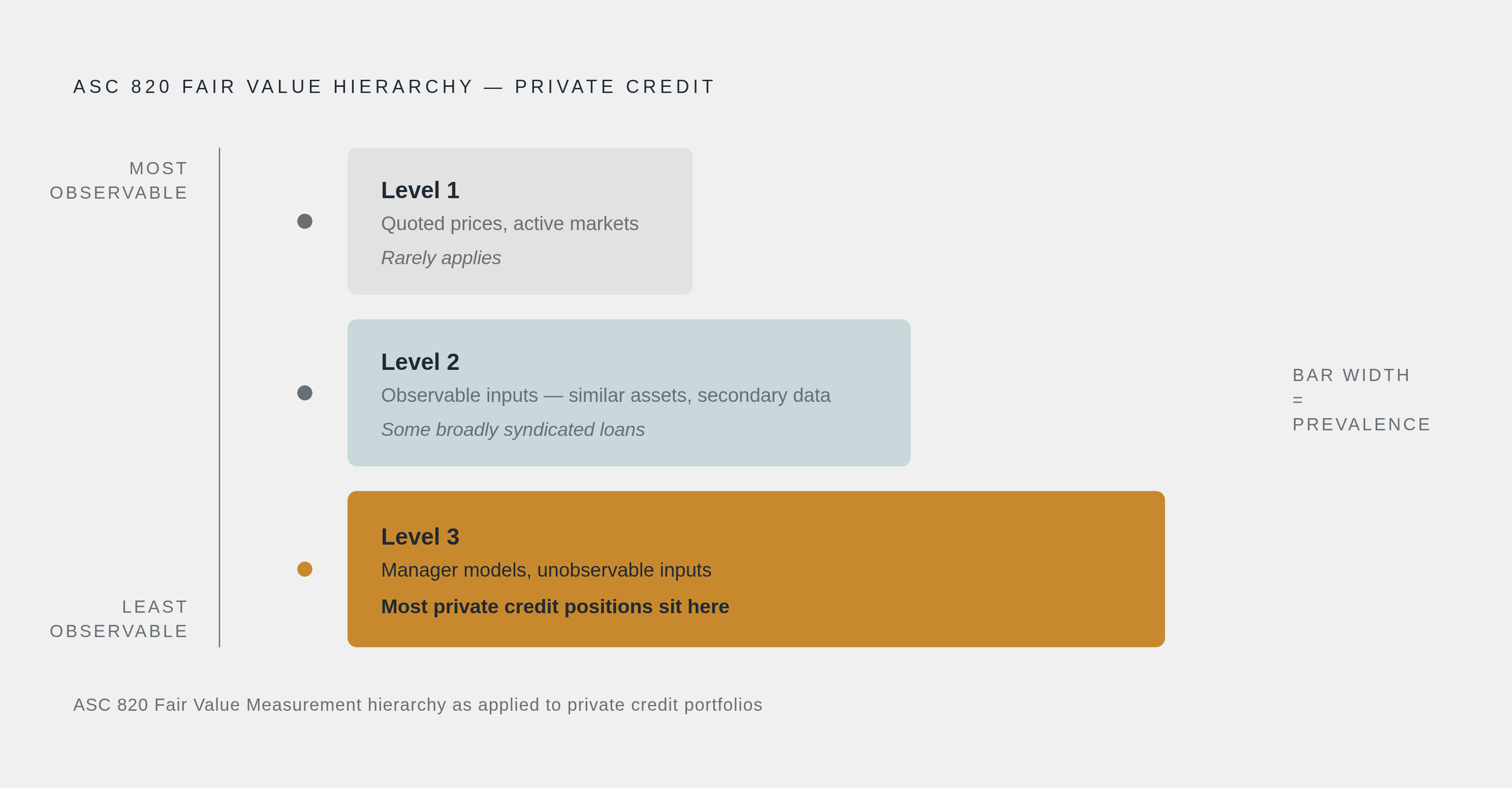
ASC 820, Fair Value Measurement, governs the valuation of illiquid positions under U.S. GAAP through a three-tier hierarchy. Level 1 uses quoted prices in active markets for identical assets, though few private credit positions meet that test. Level 2 uses other observable inputs, which include prices for similar assets or data from the secondary market for some broadly syndicated loans. Most private credit positions sit in Level 3. Here, models built by managers and unobservable inputs take the place of direct market evidence, so more judgment must be recorded and explained.
For performing loans, discounted cash flow is the standard analytical framework. The model projects expected interest and principal payments, then discounts them at a rate reflecting current credit risk and market conditions for comparable instruments. The rate must reflect how borrower credit quality has changed since origination, and changes in comparable market spreads can move fair value even if the borrower’s performance stays the same.
What happens when contractual payments are no longer a reliable forecast? For stressed or impaired loans, expected credit loss analysis turns to how much can be collected, based on collateral value and the borrower’s condition. A loan can begin with a performing-loan DCF and migrate toward a recovery-focused analysis as it deteriorates. That progression introduces judgment over both the timing of the change and the assumptions used.
The AICPA’s Accounting and Valuation Guide: Valuation of Portfolio Company Investments of Venture Capital and Private Equity Funds and Other Investment Companies provides industry-specific guidance that most U.S. private funds follow alongside ASC 820.
Where valuation judgment enters and why it creates conflict-of-interest risk
Level 3 judgment has a direct financial consequence for the general partner. The GP proposes the initial mark, even when an independent valuation firm participates, and that mark affects NAV-based management fees, performance fee accruals, and carried interest. The structural conflict arises because the party proposing value also has an economic interest in the result, making governance essential to a defensible process.
A borrower that has recently become stressed may call for a modest or severe impairment, and when there is little comparable transaction data, discount rates depend on internal assumptions. Near-term fundraising adds pressure to marks. These conditions make documented challenge more important than the apparent sophistication of the model. The SEC’s Division of Examinations identified fair valuation of illiquid assets, especially during market volatility, in its 2026 priorities, while the FCA published findings from its valuation review in March 2025.
In May 2026, the U.S. Attorney’s Office for the Southern District of New York was reported to be examining valuation practices at BlackRock TCP Capital Corp. after a sharp NAV reduction. Separately, FS KKR Capital Corp. reported materially lower NAV per share at March 31, 2026, following a substantial net loss. A class action had been filed on May 4, 2026, before its Q1 results were announced, based on disclosures through February 25, 2026. Neither an examination nor a filed claim establishes wrongdoing, but both illustrate why the process behind a mark can become as consequential as the mark itself.
The quarterly close process that makes a NAV defensible
A quarterly close makes valuation judgment auditable by controlling the order in which information enters the calculation. It starts with cash reconciliation, which ties the bank balance of every fund account to the administrator’s books. Cash provides a verifiable starting point. Recording subscriptions, redemptions, distributions, investments, divestments, capital calls, and expense payments follows, because incomplete capital activity can leave total NAV correct while investor allocations are wrong.
Loan valuations then enter under the fund’s stated valuation policy, applied consistently across periods. Fees and expenses are accrued, and each fair-value adjustment must have documents to support it before it is approved. The sequence prevents judgments from becoming unexplained plugs. Foreign holdings are converted at the valuation-date spot rate, with FX separated in the bridge, before fund-level NAV is calculated and allocated to investor capital accounts. GP review and approval precede investor communication, while the annual audit tests process documentation and samples loan valuations.
Independent participation adds another layer of control. Houlihan Lokey, Kroll, and Lincoln International are among the firms that review GP marks through concurrence opinions or independent valuations, although coverage does not necessarily extend to every loan. The administrator serves a distinct role. Independent NAV production provides an arm’s-length check on the manager’s numbers. Institutional LPs typically require independent administration for that check. Clear owners and sign-offs make the close calendar for producing statements a risk management tool.
How the liability side and accrual accuracy shape the final number
A misaccrued performance fee, omitted redemption payable, or mis-timed distribution payable changes the amount available to investors. The performance fee creates a particularly important feedback loop. Once the preferred return threshold and catch-up provisions are satisfied, its accrual depends on current NAV and the waterfall terms, so the liability responds to the asset marks just produced.
Management fees introduce a different source of complexity because their bases vary by fund. Some use NAV, others committed or invested capital, with definitions that can differ across structures. Timing creates further points of exposure. Approved redemptions that remain unsettled at the strike date reduce NAV for the investors who remain, and fund-level subscription facilities and warehouse lines must have both their debt and period-end accrued interest recorded. Omitting expense accruals can inflate NAV in high-income periods and depress it when expenses crystallize, distorting unit pricing and performance across periods.
What stale data and fragmented loan records do to NAV accuracy over a fund's life
A technically sound model can still value the wrong version of a borrower. In CRE lending, information from underwriting may never reach the asset management workflows that need it years later, and covenant terms may stay buried in loan documents. Teams then re-review information because they lack a continuous record. If the latest rent roll or operating statement is well over a year old, the resulting mark reflects stale evidence even when the model calculates perfectly. Precision is not the same as freshness.
If a mid-quarter DSCR breach never reaches the valuation committee, the loan stays marked on pre-breach assumptions, so NAV is wrong and the risk is detected late. A roll-forward cannot repair missing evidence by itself. Stale private equity and private credit NAVs require documented calls, distributions, estimated return, and an evidence pack, but the exercise depends on complete, current transaction and performance data. For borrower financial extraction, traceability therefore means a timestamp and a link to the source document.
How NAV is now used as lending collateral and what that raises for valuation standards
NAV now supports borrowing as well as reporting. A NAV loan provides credit against an existing portfolio’s net asset value, so its amount, terms, and risk profile depend on how accurately that value is measured. This is a legitimate financing tool. 17Capital has raised capital exclusively for NAV finance since its founding in 2008, and record fundraising in 2025 and into 2026 reflects the segment’s establishment within private credit. The interaction between valuation discretion and leverage raises concern.
Borrowing for add-on acquisitions and borrowing to accelerate LP distributions can produce different investor implications, prompting some LPs to seek clearer disclosure. Distribution financing can mask weak exit activity. An overstated portfolio mark can also support a larger NAV loan, adding leverage to already-illiquid assets and extending the consequences of valuation error beyond investor statements.
Blue Owl Capital capped withdrawals at five percent after investors sought significant redemptions from its flagship fund and a technology-focused vehicle, honoring less than a quarter of requests. The episode illustrates the mismatch between illiquid assets and investor redemption expectations that a reported valuation can obscure.
What drives NAV accuracy and where risk concentrates in the number
NAV accuracy sits on a spectrum rather than dividing neatly into correct and incorrect. The estimate must be close enough to fair value to support the decision at hand. For CRE professionals, that calls for examining its foundations. Does a valuation committee document its review, support adjustments before approval, and apply methodology consistently? Does an independent administrator calculate NAV, and how much of the portfolio receives third-party concurrence or independent marks?
Coverage gaps leave more judgment with the GP alone, with third-party coverage below 50% a warning sign for reliability. Data freshness, complete period-end accruals, and an audit trail connecting every mark to its methodology, inputs, and source documents remain separate tests. A strong answer to one does not resolve the others. For CRE portfolios, manual document review, fragmented covenant tracking, and quarterly-batch financial spreading concentrate exposure at the loan-data layer.
Purpose-built CRE asset intelligence platforms address that exposure through automated financial spreading, source-linked extraction, and covenant breach detection as events occur. The SEC’s 2026 priorities and the FCA’s work on valuation conflicts direct attention toward the controls around NAV, making the supporting infrastructure part of the compliance surface. A number intended for LP reporting, NAV-backed borrowing, or regulatory examination must be supported by evidence fit for that use.