SR 11-7 Compliance for AI Governance in Lending
SR 11-7's rescission leaves lenders governing AI under adjacent rules.

SR 11-7 compliance for AI governance in lending now requires a different regulatory map. The guidance has been superseded, but validation, documentation, human accountability, and explainability remain central to sound governance. For commercial real estate lenders, the challenge is to preserve those controls while governing generative and agentic AI under the adjacent frameworks that still apply.
SR 11-7 is gone, but the governance obligations it carried are not
For compliance teams that felt relief in April 2026, the rescission of SR 11-7 invited the wrong conclusion. The Federal Reserve, OCC, and FDIC jointly issued Revised Guidance on Model Risk Management on 17 April 2026 through SR 26-2, OCC Bulletin 2026-13, and FIL-15-2026. The agencies simultaneously rescinded SR 11-7, OCC Bulletin 2011-12, the Model Risk Management booklet of the Comptroller’s Handbook, FIL-22-2017, and FIL-27-2021.
The replacement’s legal status deserves careful reading. The OCC’s bulletin states that the guidance “does not set forth enforceable standards or prescriptive requirements” and that non-compliance with it will not result in supervisory criticism. That is a real limit. It does not, however, displace the laws, risk-management responsibilities, or supervisory frameworks governing a bank’s lending and operations. Examiners still apply model risk principles proportionate to an institution’s size and risk profile.
The practical distinction is between a supervisory framework and an enforceable duty. A compliance program anchored only to a rescinded document no longer explains the bank’s current governance approach adequately. Updating that reference is therefore more than housekeeping, but an outdated citation alone should not be confused with a violation of non-binding guidance. The institution needs to explain and evidence the controls that govern its models today.
What the successor framework SR 26-2 preserves from SR 11-7
SR 26-2 preserves the three-part validation architecture of conceptual soundness, outcomes analysis, and ongoing monitoring. Conceptual soundness concerns documented design rationale, development evidence, and testing against intended purpose. Scope is part of that assessment. A credit model validated for one population cannot silently move to another without revalidation. For a CRE lender, the relevant question is not merely whether a model works, but whether its design supports the use the bank makes of it.
Outcomes analysis tests that proposition against real results. In CRE underwriting, it means back-testing model-flagged risk against actual loan performance. Ongoing monitoring continues the comparison after deployment and approval. Validation also retains an independence requirement. Objective experts need sufficient independence to maintain objectivity, with the rigor and effectiveness of review taking precedence over separate reporting lines.
The governance infrastructure remains equally recognizable. SR 26-2 keeps a formal model inventory, clear documentation, clear roles for those responsible, and oversight by the board or senior management. Governance intensity scales with complexity, uncertainty, breadth of use, and potential impact, all significant dimensions for modern AI. Vendor sourcing does not remove bank responsibility. The guidance explicitly strengthens third-party model inclusion, so a bank using a fintech, cloud, or AI platform model still needs enough understanding to validate its use.
The governance gap SR 26-2 deliberately left open around generative and agentic AI
SR 26-2 expressly states, “Generative AI and agentic AI models are novel and rapidly evolving. As such, they are not within the scope of this guidance.” The agencies have announced a forthcoming request for information on model risk management and banks’ use of AI, including generative and agentic systems.
Where, then, does an excluded system belong? Change management, third-party risk, operational risk, fair lending, and board-level governance still provide routes for examination. The gap in the model risk guidance’s formal scope leaves the institution’s accountability intact. This distinction becomes important when an agent orchestrates underwriting by pulling rent rolls, running risk models, flagging anomalies, and routing exceptions without manual handoffs. Removing the handoffs does not remove the need to govern the workflow.
SR 26-2 also narrows the definition of a model by excluding deterministic, rule-based processes. That gives deterministic decision engines a clearer position within the framework’s boundaries, but it does not settle the governance of a mixed AI workflow. Different components can fall under different controls. The lesson for lenders is to document those boundaries deliberately rather than let a technology’s classification decide whether anyone oversees it.
Why CRE lending concentrates the governance stakes more than other loan types
CRE combines document-intensive underwriting with unusually consequential decisions. A missed covenant breach or a miscalculated DSCR can shape the trajectory of a multi-hundred-million-dollar loan and trigger a workout. That concentration of exposure makes automation attractive while raising the cost of weak validation, incomplete documentation, or misplaced reliance on an output.
Commercial pressure is accelerating the shift. With $875 billion in commercial real estate loans maturing and rates rising after the Fed’s September 2026 hike, lenders are turning to automation to clear their deal backlogs. Institutions deploying purpose-built AI underwriting platforms report substantial reductions in analyst time per commercial loan and time-to-decision. Speed creates its own governance test. Controls built for slower work that people handed off to one another need to keep pace with the systems taking its place.
The benefits also extend beyond origination. In a large-portfolio monitoring example, AI flagged assets at risk of DSCR breach that traditional quarterly reporting would have caught at a fraction of the rate. Earlier warning can create room for a waiver negotiation that avoids a forced workout. Yet the gain creates dependence on the monitoring model’s judgments. The lender therefore needs to substantiate and review the signals on which it acts.
What explainability and adverse action requirements still demand, despite CFPB rollbacks
The CFPB used FR Doc 2025-08286 to withdraw Circular 2022-03 on 12 May 2025. The circular had said that Regulation B’s adverse-action notice requirement applied to credit decisions based on complex algorithms. Following withdrawal of the interpretive instrument, Regulation B’s requirement at 12 CFR 1002.9 still applies, including to business credit, even though other parts of the regulation have changed. Specific, accurate principal reasons remain necessary, and algorithmic complexity is not a defense.
Fair-lending developments require a separate distinction. The CFPB’s Winter 2025 Supervisory Highlights, Advanced Technologies Special Edition, Issue 38, found disparate-impact risk in AI-augmented underwriting that used many variables that could stand in for prohibited characteristics. That analysis still serves as a baseline for how fair-lending exams are carried out through 2026. But FR Doc 2026-07804 removed Regulation B’s disparate-impact provision from § 1002.6(a), effective 21 July 2026, and that change is being challenged in court. Lenders should track that position as unsettled, while state regulators and private litigants continue to pursue algorithmic-discrimination claims independently.
For CRE underwriting, the operational test remains concrete. Can an AI-influenced adverse decision be mapped to actionable, loan-specific reasons? A black-box output that cannot support that explanation creates exposure regardless of the current federal enforcement emphasis. Purpose-built platforms that give source citations with the data they extract and the decisions they return can more readily supply supporting evidence than general-purpose LLMs that cannot trace their outputs. Traceability supports the explanation, though it does not replace the bank’s duty to provide accurate reasons.
Vendor governance and GLBA obligations that sit outside model risk entirely
GLBA obligations do not transfer to an AI vendor. The bank is still responsible for how data is handled across its AI ecosystem, whether or not a tool falls within SR 26-2. Risks come from how data flows through vendors, how employees use unapproved tools, and what models infer from customer data. Model classification cannot answer those questions. A sound validation review and a sound privacy review each deal with different risks.
Before an AI tool goes live, four questions need written answers. Does the vendor retain the data after processing? Does the vendor use the data to train models? Does the vendor share data with subprocessors? Do the vendor’s retention practices align with the institution’s GLBA obligations?
At a minimum, a vendor’s security architecture must have SOC 2 Type II certification, comply with GLBA, and pass the bank’s vendor risk assessment. Isolated tenant architecture and the absence of cross-training on institutional data can support that review, but the institution still needs answers about retention and subprocessors. An architecture label is not an attestation. As of April 2026, the House Financial Services Committee was debating changes to GLBA, including a uniform federal financial-data privacy standard and rights to access and delete data. Lenders should monitor that debate as a potential expansion of compliance scope.
Proportionality under SR 26-2: what community and regional CRE lenders actually owe
SR 26-2 is framed as most relevant to banking organizations with more than $30 billion in total assets. Community banks below that threshold are not expected to apply the same governance intensity as the largest institutions. Proportionality changes the scale of the work. It does not mean that AI can operate outside policy, or that vendor adoption substitutes for an institution’s own assessment of risk and intended use.
OCC Bulletin 2025-26 makes one important limit explicit. Community banks still need to carry out model validation, but they are not required by default to do it every year. The recurring examiner finding for smaller institutions in 2024–2026 is more basic than a missed annual schedule. Their existing model risk policies do not reference AI/ML or foundation models at all. The practical priority is therefore inclusion, followed by calibration to the tool’s risk.
For a community or regional CRE lender, that means a tiered inventory distinguishing high-stakes credit decisions from informational extraction. The bank’s own intended-use documentation should explain why a material tool fits its portfolio, supplementing the vendor’s model card. Where vendor LLM weights cannot be inspected, output-based validation provides a workable approach to testing a tool’s results for its intended use, with quarterly comparison against a labeled benchmark set accepted by examiners.
The supporting artifacts include prompt templates, retrieval boundaries, escalation thresholds, and human-review checkpoints that a vendor manager can produce on demand. Change control belongs in the same framework. A frequent failure is a line-of-business deployment with no change-control ticket and no defined intended-use boundary. The FFIEC agencies’ collective guidance, including the 2021 interagency BSA/AML model risk statement and the 2023 third-party risk guidance, provides authority across bank sizes. No asset threshold removes the relevance of model risk, third-party risk, fair-lending, and BSA/AML frameworks altogether.
The eight examiner questions CRE lenders should be ready to answer today
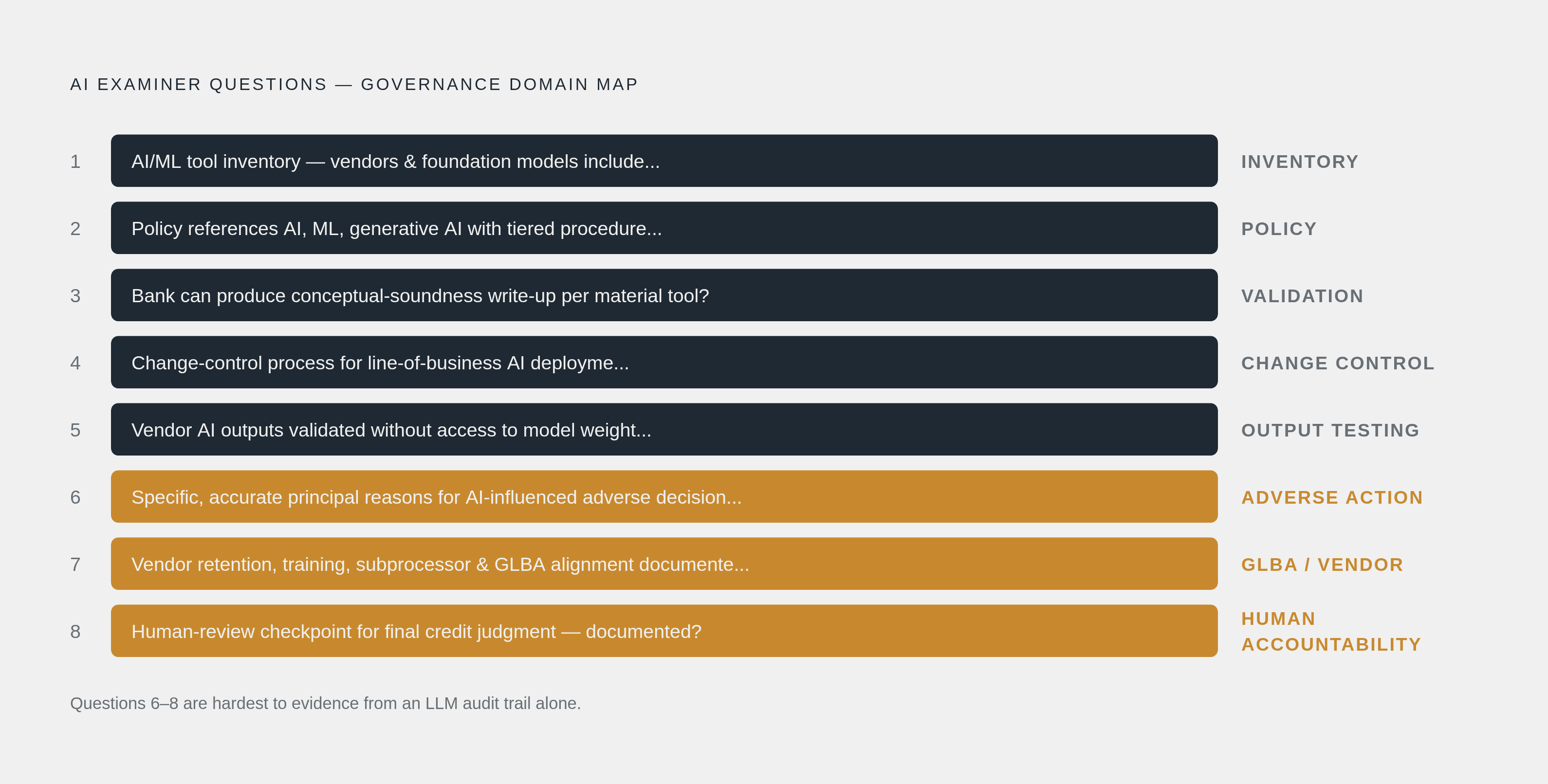
First, examiners ask whether the model inventory includes all AI and ML tools, including vendor-supplied LLMs and foundation models. The second is whether the model risk policy explicitly references AI, ML, and generative AI, with defined governance procedures for each tier. These establish whether the bank knows what it uses and has assigned the tools a place in governance.
Third, examiners ask whether the bank can produce its own conceptual-soundness write-up for each material AI tool to supplement vendor documentation. The fourth asks what change-control process governs a line of business deploying or modifying an AI tool. The fifth asks how the institution validates vendor AI outputs when it cannot inspect the model weights. Together, these questions test control over use and change. Procurement alone does not answer them.
Sixth, examiners ask whether the bank can provide specific, accurate principal reasons for any adverse credit decision influenced by AI. The seventh asks whether each vendor’s retention, training, subprocessor sharing, and alignment with GLBA retention obligations are documented in writing. The eighth asks what human-review checkpoint governs final credit judgment and how that review is documented. Evidence shows how the answers hold up in the bank’s actual lending.
Systems that log activity, cite sources, and produce explainability artifacts during operation can answer much of the question set from their audit trail. General-purpose LLMs require the institution to build that trail separately. Purpose-built CRE platforms organized around a firm’s intellectual property and templates, with documented retrieval boundaries and embedded review checkpoints, are positioned to make auditability part of the workflow ahead of an examination.
Human-reviewed automation provides the operating model for that approach. AI handles extraction, spreading, monitoring, and first-draft commentary, while experienced credit officers make and document final judgments. The agencies’ planned request for information shows that they will take a closer look at generative and agentic AI, though guidance is still to come. Lenders that build inventories, vendor GLBA attestations, explainability artifacts, and review checkpoints now will have governance infrastructure ready for that next stage. The alternative is to retrofit accountability after deployment has already outrun it.